
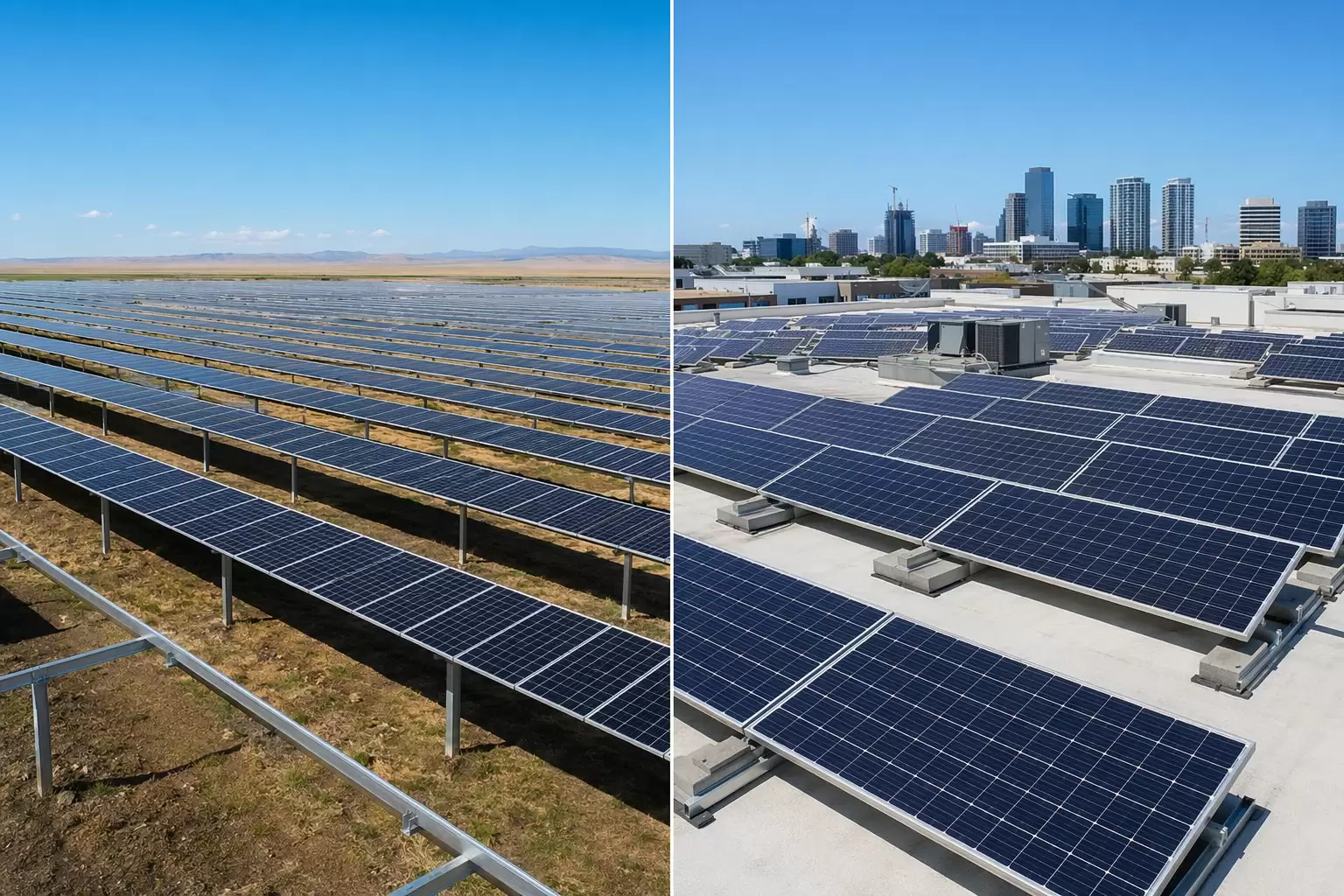
The solar mounting structure market divides into two fundamentally different installation types: ground-mount arrays and rooftop systems. Each imposes different structural requirements on the mounting profiles — and therefore different requirements on the roll forming machine that produces them.
This guide compares the two applications, explains how their structural differences translate into machine specification differences, and helps you decide which machine investment fits your target market.
The Structural Difference Between Ground Mount and Rooftop
Ground mount: Panels are mounted on freestanding structures driven into or anchored to the ground. The structure must resist wind uplift, wind lateral load, snow load, and self-weight across spans of 3–8 meters between pile supports. Profiles are typically heavier gauge (2.0–4.0 mm), longer (4–6 meters), and subject to larger bending moments.
Rooftop (commercial/industrial): Panels are mounted on ballasted or mechanically attached frames on a flat or pitched roof. The structure transfers load to the roof membrane or purlins — the mounting profile spans are shorter (1.5–2.5 meters), profiles are lighter gauge (1.5–2.5 mm), and weight is a critical constraint to minimize roof loading.
These structural differences cascade directly into profile specification and machine configuration.
Profile Comparison: Ground Mount vs Rooftop
Machine Configuration Differences
Material Choice: Steel or Aluminum?
Both ground mount and rooftop applications are produced in galvanized steel and aluminum alloy — but the market preference differs significantly.
Ground mount — steel dominant in emerging markets: In Southeast Asia, the Middle East, Africa, and Latin America, ground-mount solar structures are predominantly hot-dip galvanized steel. Lower material cost, higher structural strength for long spans, and established supply chains make steel the default choice. Aluminum is used for coastal sites and premium projects.
Rooftop — aluminum growing rapidly: For commercial and industrial rooftop systems, aluminum is increasingly specified because it is significantly lighter (reducing roof loading), is naturally corrosion-resistant (no coating required), and does not require grounding for electrical isolation from the panel frame. In Europe and coastal regions, aluminum rooftop mounting systems are the standard.
Which Machine Should You Buy First?
For most manufacturers in Southeast Asia, Middle East, and Africa: Ground mount steel machine is the better first investment. The utility-scale solar market in these regions is growing rapidly, orders are large and consistent, and the steel material supply chain is well-established.
For manufacturers targeting Europe, coastal Asia, or commercial rooftop: Aluminum rooftop machine — or an adjustable machine capable of both steel and aluminum — is the appropriate configuration.
Can One Machine Do Both?
Yes — with careful specification. An adjustable-width machine configured for 1.5–3.5 mm material thickness covers both rooftop and ground mount profiles in the same gauge range. If ground mount requires 4.0 mm steel, that typically requires a heavier-duty machine than rooftop profiles justify.
For aluminum processing, the machine needs mirror-polished rollers and an in-line lubrication system regardless of whether it is used for ground mount or rooftop profiles.
If your market clearly requires both, discuss a dual-configuration machine with your supplier — confirming that the motor power, shaft diameter, and forming station count are sized for the heaviest material you will process.
FAQ
What is the minimum production volume to justify a ground mount solar machine? At 15 m/min forming speed and standard 6-meter rail length, a machine produces approximately 150 rails per hour. For a 10 MW solar project using approximately 12,000 rails, one shift of production covers the requirement in under two days. At this volume, a machine paying $80,000–$120,000 recovers its investment within 2–4 projects.
Can the same machine produce both C-channel and Z-purlin? Yes — with separate tooling sets. Changeover time: 2–4 hours (mill replacement method) or 6–8 hours (spacer adjustment). If you regularly switch between the two profiles, specify the mill replacement method upfront.
What slot pattern is standard for solar rails globally? The most widely used slot pattern is 33 mm pitch, 22 mm × 11 mm slot dimensions. Some European system brands specify proprietary dimensions — verify against your target system brand before specifying the punch die.
Conclusion
Ground mount and rooftop solar bracket machines share the same basic roll forming principle but differ significantly in the material thickness they process, the profile geometry they produce, and the forming force they must apply. Matching the machine to your target installation type is the foundation of a productive solar bracket manufacturing operation.
Define your market, confirm your material specification, and choose a machine configured for the thickness range and profile geometry your customers actually require.
Contact our engineering team with your target profile drawing and market geography — we will specify the right configuration and provide a detailed proposal.
Related Articles:
