
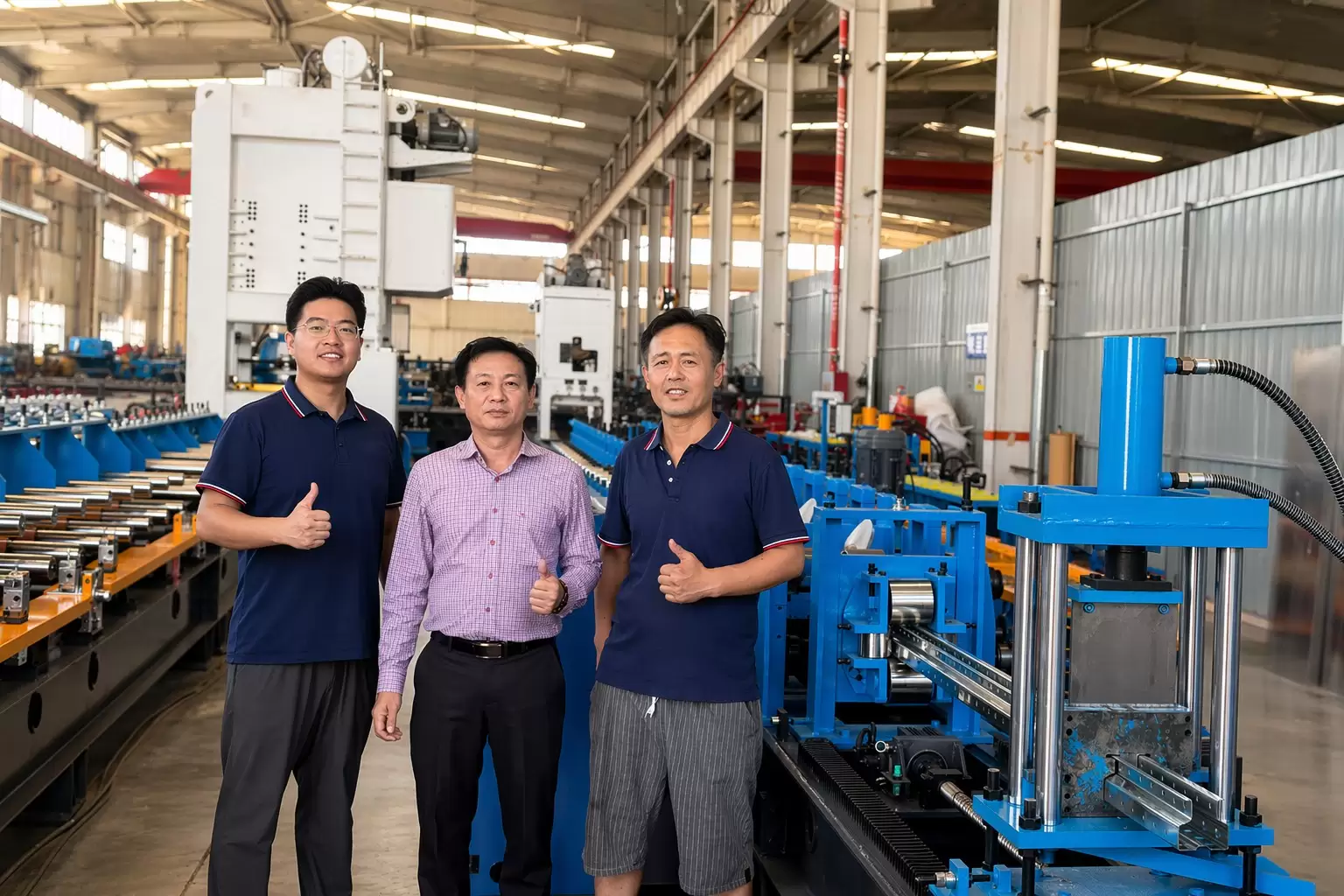
China is the world's largest manufacturer of roll forming machines — and for good reason. Chinese manufacturers offer competitive pricing, broad product range, and increasingly strong engineering capability. But buying capital equipment from a supplier 5,000 kilometers away carries real risk if you do not ask the right questions before signing.
This guide gives you the ten questions that separate a reliable supplier from one who will cost you time, money, and production downtime.
Question 1: Are You the Manufacturer or a Trading Company?
This is the first and most important question. China has thousands of roll forming machine trading companies — businesses that source machines from factories and resell them with a markup, without any engineering capability of their own.
Why it matters: If a problem arises with your machine — a profile tolerance issue, a control system fault, a tooling specification error — a trading company has no engineering team to solve it. They pass the problem to the factory, which may or may not respond. A direct manufacturer has engineering staff who designed the machine and can diagnose and resolve issues directly.
How to verify: Ask for the factory address and request a video call showing the production floor. A real manufacturer will show you machines being assembled, CNC tooling being machined, and engineers at work. A trading company often cannot provide this.
Question 2: Can You Provide the Roller Tooling Drawing and Material Specification?
The roller tooling is the most critical and most expensive component of any roll forming machine. The profile it produces is only as accurate as the tooling that forms it.
What to ask for:
- The CAD drawing of the roller profile with dimensional tolerances
- The roller material specification (alloy grade and heat treatment)
- The target hardness (HRC value) of the finished roller
What the answer tells you: A supplier who can provide this information has engineering depth. A supplier who says "we use good quality rollers" without specifics is telling you they do not have engineering control over the most important part of the machine.
The standard for quality roll forming tooling: Cr12MoV alloy tool steel, quenched and tempered to HRC 58–62. Anything below this standard wears significantly faster and produces profile drift within months of production.
Question 3: What PLC Brand Do You Use — and Is Service Available in My Country?
The PLC (Programmable Logic Controller) is the machine's brain. When it fails or requires modification, you need local technical support — not a troubleshooting email from China.
Acceptable answers: Siemens, Mitsubishi, Delta, Omron — all have established service networks in most countries.
Red flag answers: "Our own control system" or a brand you cannot find online. Proprietary control systems create permanent dependency on the original supplier for any software modification, parameter change, or fault diagnosis. If that supplier becomes unresponsive, you are stranded.
Also confirm: does the supplier provide the full PLC program code, or do they password-lock it? A password-locked PLC means you cannot access your own machine's control logic without the supplier's cooperation.
Question 4: What Is Included in the Factory Acceptance Test?
A factory acceptance test (FAT) is a production run at the supplier's factory, producing your specific profile from your specified material, before the machine is shipped. It is the most important quality gate in the purchasing process.
What the FAT should include:
- Production run of minimum 100 meters of your target profile
- Dimensional measurement of the profile cross-section at multiple points along the run
- Cutting length accuracy measurement (minimum 20 pieces)
- Punching hole position accuracy measurement (if applicable)
- Written test report with actual measured values vs. specified tolerances
What to watch for: Some suppliers offer a FAT but run it with a generic profile or their own test material rather than your specification. Insist on your actual profile drawing and material grade being used in the test.
If you cannot attend in person, request a live video FAT with the dimensional measurements shown on camera.
Question 5: What Is the Warranty Coverage and Duration?
Every supplier offers "warranty." The important question is what the warranty actually covers, and for how long.
Minimum acceptable terms:
- 12 months from commissioning date (not shipment date)
- Coverage of manufacturing defects in mechanical components, electrical components, and roller tooling
- Replacement parts shipped within 7–14 days of confirmed fault
What to clarify:
- Does the warranty cover roller tooling wear? (Usually not — wear is considered normal; defects in material or geometry should be covered)
- Who pays for on-site repair labor if a warranty fault occurs?
- Is the warranty void if a local electrician modifies the electrical cabinet?
Get the warranty terms in writing in the purchase contract — not just in a promotional brochure.
Question 6: What Does On-Site Commissioning Include?
A roll forming machine shipped and installed without proper commissioning is a production risk. The machine needs to be aligned, calibrated, and test-run by an engineer who knows the machine design.
What commissioning should include:
- Foundation and leveling verification
- Full electrical connection and safety circuit test
- PLC program load and parameter verification
- Production run with your actual material until the profile meets dimensional specification
- Operator training (minimum 1–2 days)
Confirm: Is commissioning included in the machine price, or is it an additional cost? Who pays for the engineer's travel and accommodation? How long will the engineer stay on-site?
For buyers in Southeast Asia, the Middle East, and Africa, commissioning engineers from Chinese suppliers typically stay 5–10 days. Shorter than this is often insufficient for complex machines.
Question 7: What Is Your Lead Time — and What Are the Consequences of Delay?
Lead time commitments from Chinese machine suppliers are frequently optimistic. Standard machines quoted at 45 days sometimes take 70–90 days. Custom machines quoted at 60 days can take 4–5 months.
What to ask:
- What is the production lead time from order confirmation to factory-ready?
- What is the current production queue? (Ask this in a video call — factory floor activity tells you a lot)
- What happens if the machine is delivered late — is there a penalty clause?
In the contract: Include a delivery date and a penalty clause (typically 0.5–1% of machine value per week of delay, up to a maximum of 5–10%). This creates accountability and gives you contractual recourse if the supplier prioritizes other customers.
Question 8: Can You Provide References from Existing Customers in My Region?
A roll forming machine supplier who has sold to buyers in your country or region has demonstrated the ability to handle the logistics, electrical standards, and after-sales support requirements of your market.
What to ask for: Two or three customer references in your region, with contact details. Follow up — call or email them. Ask specifically about:
- Was the machine delivered on time?
- Did it perform to specification from the first week of production?
- How did the supplier respond when problems arose?
- Would you buy from them again?
A supplier who hesitates to provide references, or who provides only company names without contact details, is telling you something important.
Question 9: How Are Spare Parts Supplied After Sale?
Your machine will eventually need spare parts — a cutoff blade, a bearing, a hydraulic seal, a sensor. The question is not whether you will need them, but whether you can get them quickly when you do.
What to ask:
- What is the standard lead time for spare part delivery to my country?
- Do you keep common spare parts in stock, or are they made to order?
- Can I buy an initial spare parts kit with the machine?
- Are spare parts available from local distributors, or only directly from your factory?
Recommended: Order a commissioning spare parts kit with the machine — cutoff blade, punch die set, hydraulic seals, critical sensors, and bearing sets for the highest-load stations. The cost is modest; the production insurance value is significant.
Question 10: What Is Your Engineering Capability for Custom Profiles?
Unless you are buying a machine for a completely standard, widely-produced profile, you need to know whether the supplier can engineer custom roller tooling to your specific profile drawing.
What to ask:
- Do you use roll forming simulation software (such as COPRA or equivalent) to design the forming sequence before cutting tooling?
- Can you produce a custom profile from our drawing?
- What is the process if the profile does not meet tolerance after the FAT?
- Can you redesign and recut tooling at no charge if the initial design is incorrect?
A supplier who uses simulation software before cutting tooling significantly reduces the risk of expensive tooling rework. A supplier who cuts tooling based on experience alone is taking a calculated risk with your money.
Red Flags Summary
Conclusion
Buying a roll forming machine from China is a practical and often excellent decision. The engineering capability and value for money available from established Chinese manufacturers is genuinely strong. But the due diligence process matters — not because Chinese suppliers are unreliable, but because capital equipment purchases of this size require contractual protection and supplier verification regardless of where the machine is made.
Ask these ten questions. Put the answers in writing in the purchase contract. And choose a supplier whose answers give you confidence, not just the lowest price.
If you would like to discuss our engineering capability, review our customer references, or receive a factory acceptance test protocol for your specific profile — contact our team. We welcome the questions.
Related Articles:
