
What Is a Roll Forming Machine? The Complete Beginner's Guide
If you are entering the metal manufacturing industry for the first time, or sourcing machinery for a new production line, you have likely encountered the term "roll forming machine." But what exactly is it? How does it work? And why do thousands of manufacturers across the construction, energy, and logistics industries rely on it every day?
This guide answers every foundational question — clearly, precisely, and without jargon.
What Is a Roll Forming Machine?
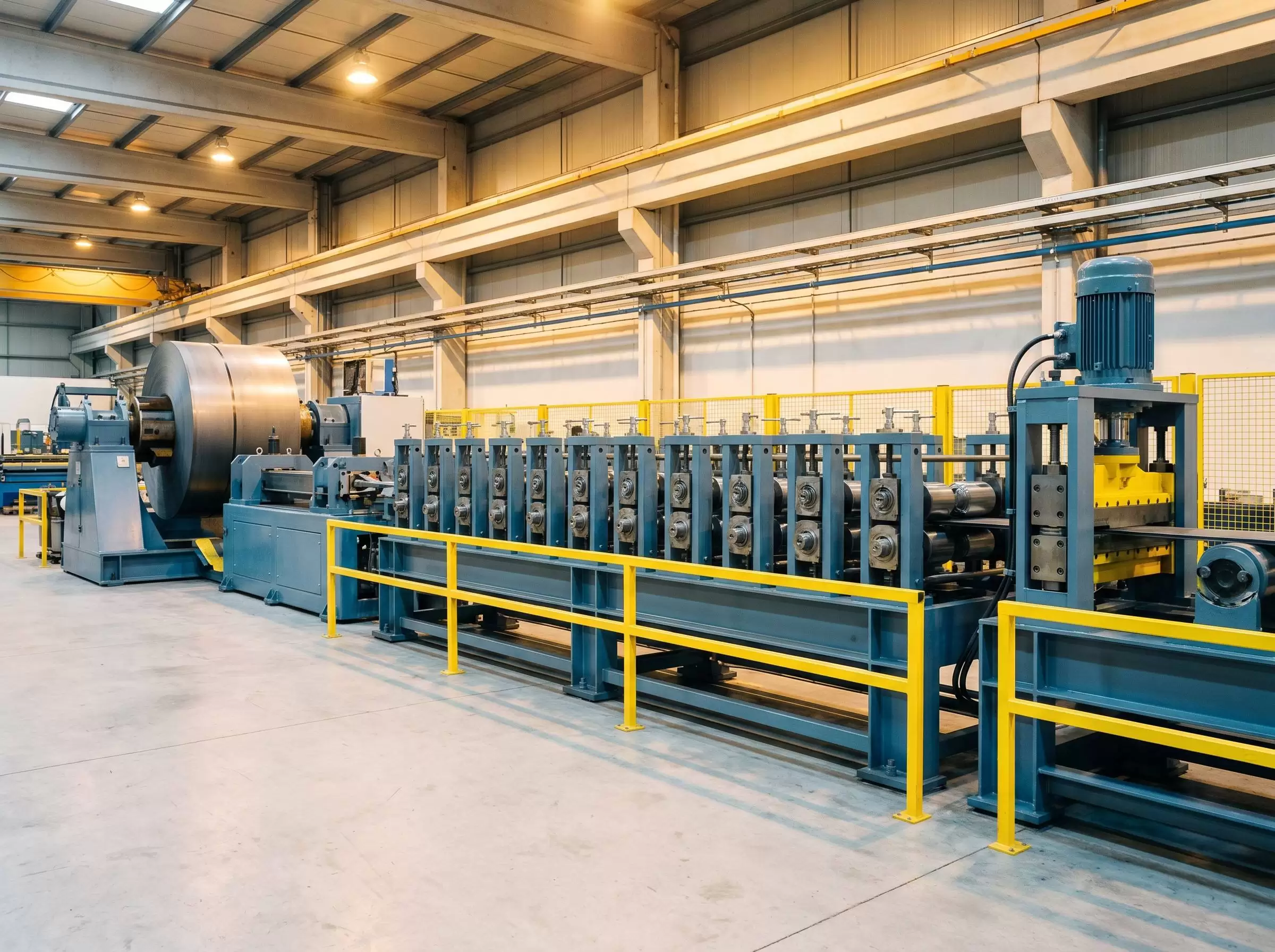
A roll forming machine is a type of metal processing equipment that continuously bends a flat metal strip or coil into a specific cross-sectional profile. The process works by feeding the metal through a series of precisely positioned roller stations, each one bending the material a small amount further until the final shape is achieved.
Unlike press brakes or stamping presses — which work on individual pieces of metal one at a time — a roll forming machine operates as a continuous production line. As long as there is coil material feeding in, finished profiles are coming out the other end. There is no interruption, no reloading, and no waiting.
This continuous nature is what makes roll forming one of the most efficient metal forming processes available for high-volume manufacturing.
How Does a Roll Forming Machine Work?
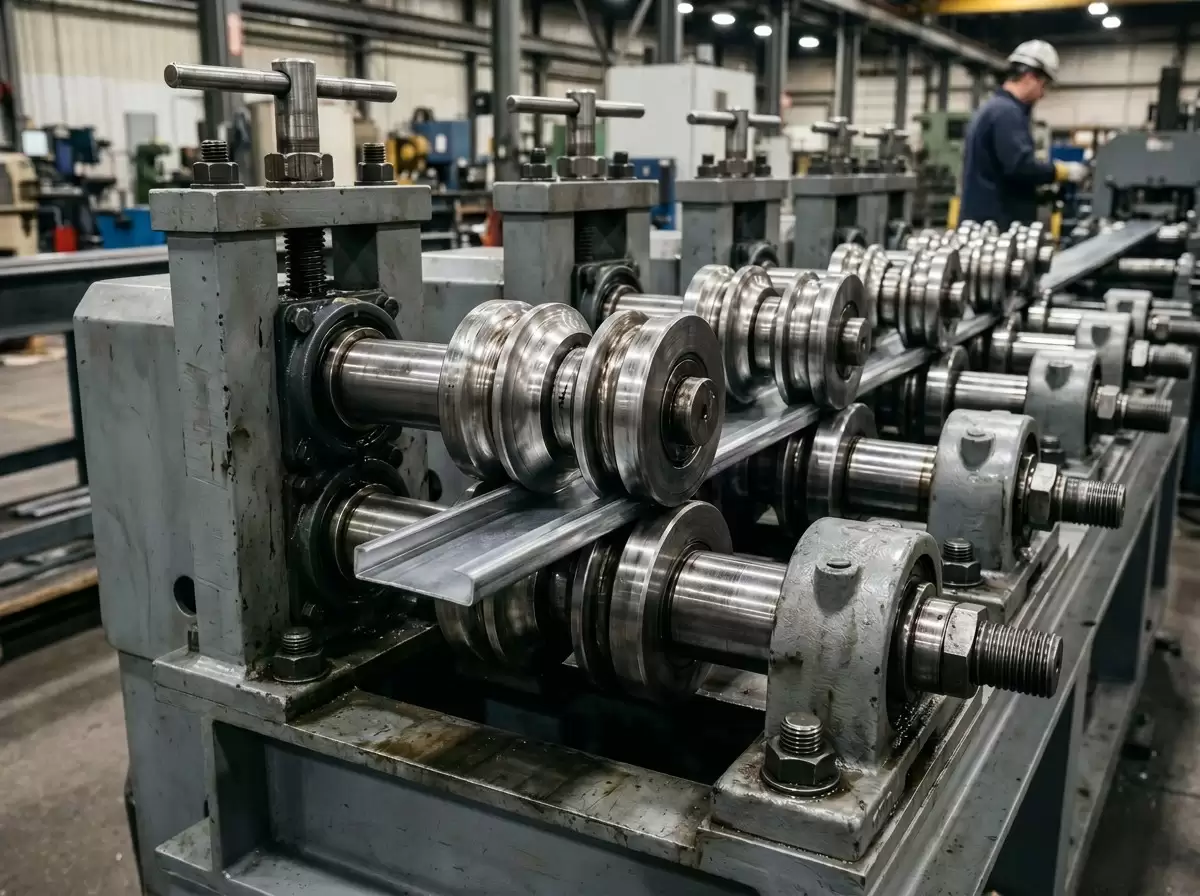
The working principle is straightforward: progressive, gradual bending.
Here is how a complete roll forming line operates, step by step:
Step 1 — Coil Loading
A metal coil (typically galvanized steel, cold-rolled steel, aluminum, or stainless steel) is loaded onto the decoiler. The decoiler unwinds the coil in a controlled manner, keeping tension consistent.
Step 2 — Straightening
The uncoiled strip passes through a straightener (also called a leveler), which flattens any natural curl from the coil. This ensures the material enters the forming stations perfectly flat.
Step 3 — Progressive Forming
The strip enters the roll forming machine body, which contains a series of roll stands — typically 8 to 30 stations depending on profile complexity. At each station, a pair of custom-engineered rollers bends the metal a few more degrees. By the final station, the metal has been gradually shaped into the target cross-section.
Step 4 — In-Line Secondary Operations (Optional)
Many production lines integrate punching, notching, embossing, or hole-drilling units directly into the line. This means holes and slots are added automatically during production — no secondary process required.
Step 5 — Cutting to Length
A hydraulic or servo-driven cutoff unit at the end of the line automatically cuts the finished profile to the specified length. The machine can be programmed to produce pieces of any length within the same run.
Step 6 — Output and Stacking
Finished profiles exit onto a run-out table, ready for packaging and shipment.
The entire sequence — from raw coil to finished, cut-to-length profile — runs automatically under PLC control, requiring minimal operator intervention.
Key Components of a Roll Forming Machine
Understanding the main components helps you evaluate machines, compare suppliers, and communicate clearly with manufacturers.
Decoiler
Holds and unwinds the metal coil. Capacity typically ranges from 3 to 10 tonnes. Hydraulic decoilers offer faster coil changes and better tension control.
Straightener / Leveler
A multi-roller unit (usually 5 to 11 rollers) that removes coil curvature before forming. Proper leveling is critical for dimensional accuracy.
Roll Forming Mill (Main Body)
The core of the machine. Contains all roll stands mounted on a rigid welded steel frame. Roll tooling is custom-manufactured from Cr12MoV alloy tool steel, hardened to HRC 58–62 for long service life.
Drive System
Powers the rollers through the entire machine. Three main types:
- Gear/chain drive — economical, fixed speed, suitable for simple profiles
- Hydraulic drive — high torque, used for heavy-gauge or thick materials
- Servo motor drive — precise speed control, energy-efficient, best for high-accuracy profiles (the current industry preference)
Punching / Notching Unit
An integrated press unit that punches holes or slots into the profile at precise positions during production. Eliminates a separate offline punching operation.
Cutoff Unit
Cuts the profile to length after forming. Options include:
- Pre-cut (cut before forming) — simpler tooling, clean ends
- Post-cut (cut after forming) — higher speed, better for complex profiles
PLC Control System
The electrical brain of the machine. Operators set target length, quantity, and speed via a touchscreen. The system controls all movements automatically and tracks production count.
What Can a Roll Forming Machine Produce?
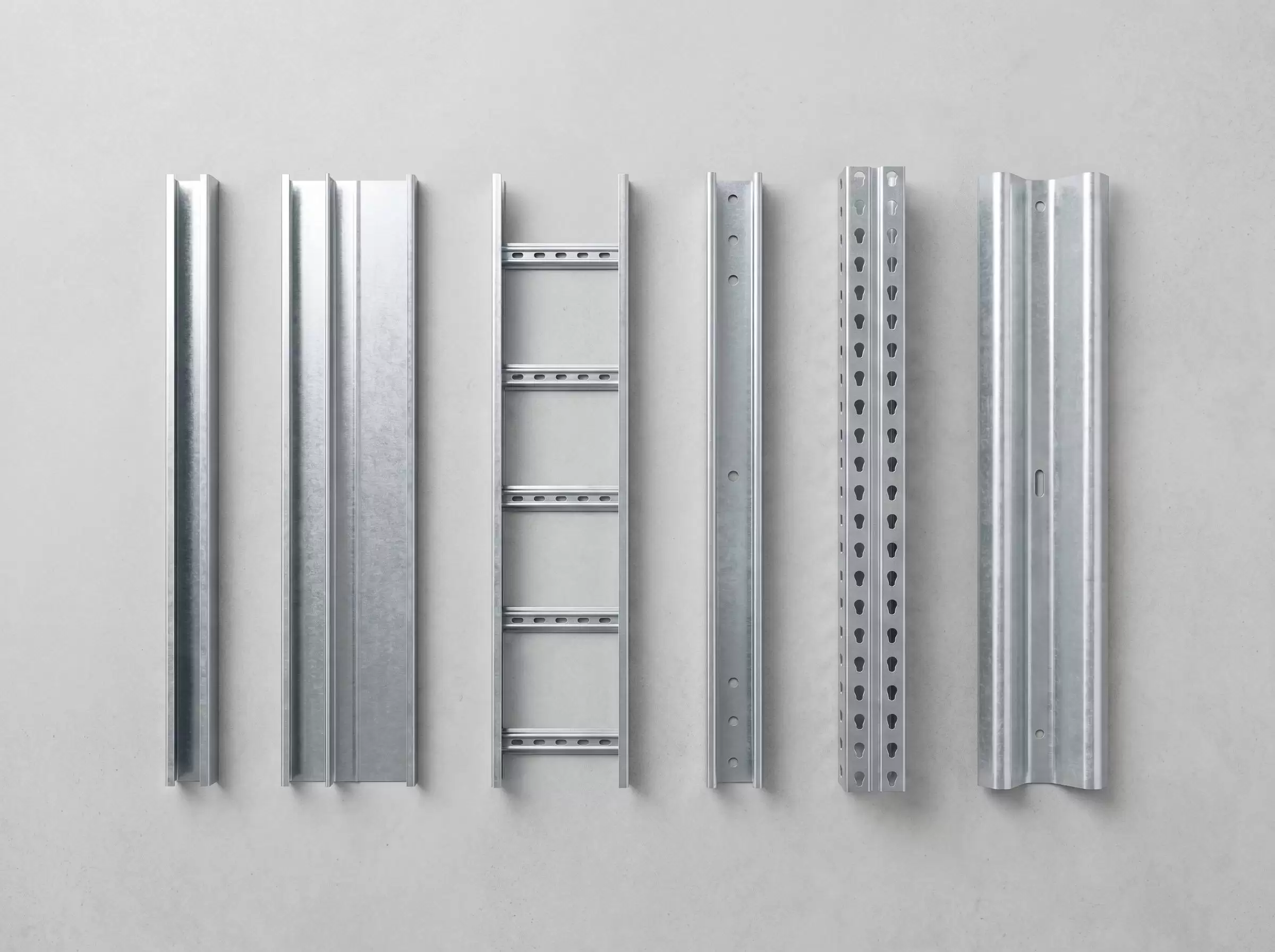
Roll forming machines are highly versatile. By changing the roll tooling, the same machine frame can produce a wide range of profiles. Common products include:
This breadth of application is why roll forming machines are found in factories across Southeast Asia, the Middle East, Africa, and Latin America — wherever metal product manufacturing exists.
Roll Forming vs. Press Brake vs. Stamping: A Quick Comparison
Buyers often ask how roll forming compares to other metal forming methods. Here is a concise answer:
The bottom line: If you need to produce long, consistent metal profiles in large quantities — roll forming is the right choice. For short runs or complex three-dimensional shapes, press brakes or stamping may be more appropriate.
What Materials Can a Roll Forming Machine Process?
Modern roll forming machines can process a wide range of metals:
- Galvanized steel (SGCC / DX51) — the most common material, used for roofing and structural profiles
- Cold-rolled steel — smooth surface, used for precision profiles
- Aluminum alloy (6061 / 5052) — lightweight, corrosion-resistant, popular in solar and food industries
- Stainless steel — used in corrosive environments
- High-strength steel (up to 1,200 MPa yield strength) — used in automotive and heavy-duty structural applications
- Pre-painted / color-coated steel — used directly for finished roofing panels
Material thickness typically ranges from 0.3 mm to 8 mm, depending on the machine configuration and profile design.
Why Choose a Roll Forming Machine?
For manufacturers producing metal profiles at scale, roll forming offers advantages that no other process can match:
1. Continuous, high-speed production
Forming speeds range from 5 to 60 m/min on standard machines, with high-speed models reaching 120 m/min. A single shift can produce thousands of meters of finished profile.
2. Near-zero material waste
Material utilization of 97–99.5% means almost every gram of purchased coil becomes sellable product. This is a significant cost advantage over stamping.
3. Consistent dimensional accuracy
Because every meter of profile passes through the same set of rollers, dimensional variation is minimal. Cross-sectional tolerances of ±0.2 mm are standard on well-maintained equipment.
4. In-line secondary processes
Punching, embossing, notching, and welding can be integrated directly into the line, eliminating separate workstations and the labor costs associated with them.
5. Low per-unit operating cost
Once tooling is amortized, the per-meter cost of roll-formed profiles is extremely competitive — especially on runs of 50,000 pieces or more.
How to Choose the Right Roll Forming Machine
Before purchasing, clarify five key requirements with your supplier:
- Target profile — Provide a cross-section drawing. Profile complexity determines how many forming stations are needed.
- Material specification — Thickness, type, and yield strength of the metal you will process.
- Production volume — Daily or monthly output target determines the required forming speed.
- Secondary operations — Do you need in-line punching, notching, or embossing?
- Electrical standards — Confirm voltage and frequency requirements for your country (380V/50Hz is standard in China; custom configurations are available).
A reputable manufacturer will review your profile drawing, recommend the correct number of forming stations, and provide a machine specification sheet before quoting.
Frequently Asked Questions
How long does it take to manufacture a roll forming machine?
Standard machines typically take 30 to 60 days. Custom machines with unique profiles require 60 to 90 days, including tooling design, machining, assembly, and factory testing.
Can one machine produce multiple profiles?
Yes — with a quick-change tooling system (raft tooling), the same machine body can switch between profiles in 30 to 45 minutes. This is ideal for manufacturers who produce several different product types.
What maintenance does a roll forming machine require?
Regular lubrication of roller bearings, periodic inspection of roll tooling for wear, and cleaning of forming stations are the core maintenance tasks. Well-maintained tooling can last 5 to 10 years.
Is roll forming suitable for aluminum?
Yes. Aluminum is widely roll-formed for solar mounting structures, cable trays, and architectural profiles. The machine configuration needs to account for aluminum's lower yield strength and greater springback compared to steel.
Conclusion
A roll forming machine is the backbone of efficient, high-volume metal profile manufacturing. By continuously and progressively bending metal coil into precise shapes, it delivers speed, consistency, and material efficiency that no other process can replicate at scale.
Whether you are manufacturing cable trays for a data center project, solar mounting brackets for a photovoltaic plant, or pallet rack uprights for a warehouse system — a properly specified roll forming machine is the production solution that makes it economically viable.
If you have a profile in mind and want to understand what machine configuration is right for your production requirements, contact our engineering team. We will review your drawing, answer your technical questions, and provide a detailed proposal — at no obligation.
Related Articles:
