
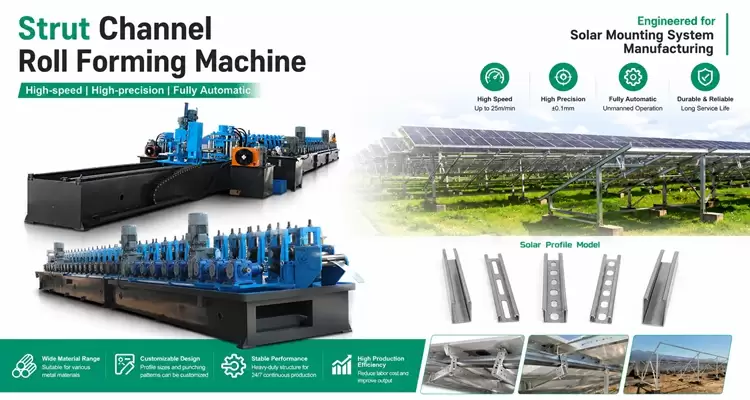
Strut Channel Roll Forming Machine: Types, Specs & Buying Guide
Walk into any data center, industrial plant, commercial building, or solar farm, and you will find strut channels holding everything together — cable trays, conduit runs, HVAC ducts, pipe supports, solar panel frames. The strut channel is one of the most widely used structural components in modern construction.
And behind every strut channel factory's output is a single machine: the strut channel roll forming machine.
This guide covers everything a buyer needs to know: what profiles the machine produces, how it works, which punching system to choose, and what specifications to compare before placing an order.
What Is a Strut Channel Roll Forming Machine?
A strut channel roll forming machine is a continuous cold-forming production line that converts flat steel coil into U-shaped strut channel profiles — also known as unistrut, framing channel, or support channel. The machine feeds raw coil through a series of roller stations that progressively bend the metal into the target cross-section, while an integrated punching unit stamps the characteristic slot or hole pattern into the channel face.
The finished product is a structural support component used across construction, electrical, mechanical, solar, and logistics industries worldwide.
Strut Channel Profile Types: What Can the Machine Produce?
Understanding the range of profiles helps you specify the right machine configuration. Common strut channel types produced by roll forming include:
Standard Single Channel (41×41 mm)
The most widely used profile globally. The U-shaped 41×41 mm (1-5/8" × 1-5/8") channel is the accepted standard for electrical, mechanical, and general construction support. Compatible with the broadest range of spring nuts, clamps, and fittings.
Applications: Cable tray support, conduit mounting, pipe brackets, general framing.
Half Channel / Mini Channel (41×21 mm)
A shallower version of the standard profile. Lighter weight and more compact, suited for light-duty support of instrument tubing, small cable bundles, and sensor mounting.
Applications: Instrumentation, lightweight cable management, low-clearance installations.
Double Channel (Back-to-Back)
Two standard channels welded or formed back-to-back for dramatically increased rigidity and load capacity. Used where single channels cannot span the required distance or carry the required load.
Applications: Cantilever supports, seismic bracing, heavy-duty pipe racks.
Deep Profile (82 mm height)
A taller channel that provides higher load capacity and longer span capability. Used in structural applications where standard-depth channels would deflect excessively.
Applications: Primary structural support in industrial plants, overhead pipe systems.
Solar Strut / Photovoltaic Channel (C/U/Z section)
A variation optimized for solar panel mounting structures. Typically produced in C-section, U-section, or Z-section profiles from galvanized steel or aluminum alloy. High demand from solar EPC contractors and PV bracket manufacturers.
Applications: Ground-mount and rooftop PV systems, solar carport structures.
Slot and Hole Patterns: Slotted vs Solid
Beyond the profile shape, buyers must specify the hole pattern. This is a critical decision because it determines which punching system the machine needs.
How a Strut Channel Roll Forming Machine Works
A complete strut channel production line operates in this sequence:
1. Coil Loading Steel coil — typically 1.5 to 3.0 mm thick galvanized steel (SGCC / DX51), carbon steel, stainless steel, or aluminum alloy — is loaded onto a hydraulic decoiler (3–5 tonne capacity standard).
2. Leveling A 9-roller leveler (4 upper, 5 lower) flattens coil curl and stress before the strip enters the punching unit. Flat, stress-free material is critical for accurate hole pitch in the next stage.
3. Punching (Most Critical Stage) Before the strip is formed into a U-shape, the punching unit stamps the slot or hole pattern. Why punch before forming? Because punching a flat strip is far more accurate than punching a formed channel. Hole position accuracy on the flat is typically ±0.5 mm.
4. Progressive Roll Forming The punched strip enters the main forming mill — typically 16 to 20 roller stations — and is progressively bent into the final U-shaped channel profile. The inward-curled lips that give strut channel its characteristic stiffness are formed in the final stations.
5. Cutting to Length A hydraulic or flying-saw cutoff unit cuts the finished channel to the specified length — commonly 3 m, 4 m, or 6 m for standard market lengths, or custom lengths per order.
6. Output Finished channels exit onto a run-out table. Automatic stackers can be integrated for high-volume operations.
The Three Punching Systems: Which One Is Right for You?
The punching unit is the most important specification decision for a strut channel machine. It determines production speed, hole accuracy, and how quickly you can switch between slot patterns.
How to decide:
If your factory produces one standard slot pattern at moderate volume — a hydraulic punch delivers solid performance at the lowest equipment cost. If you run a single pattern at maximum throughput across multiple shifts, rotary punching is the most productive choice. If you serve multiple customers who specify different slot patterns, a mechanical servo press pays for itself in changeover time savings within months.
Key Technical Specifications
Compare suppliers on these parameters when evaluating machines:
Multi-Profile Capability: One Machine, Multiple Channel Sizes
A common buyer requirement is producing both 41×41 mm and 41×21 mm channels on the same machine. Two methods are used:
Spacer adjustment method: Workers manually adjust spacers on all upper and lower rollers to change the profile width. Changeover time: 6–8 hours. Suitable for operations that rarely switch profiles.
Mill replacement method: The entire roll forming mill module is mounted on a base and can be swapped out as a unit. Changeover time: under 2 hours. Suitable for operations that switch profiles regularly.
If your order mix requires frequent profile changes, specify the mill replacement method — the upfront cost difference is recovered quickly in labor savings.
Materials and Surface Finishes: What Your Machine Needs to Handle
The strut channel market requires a range of input materials and surface finishes. Confirm your machine's capability against your production requirements:
Input materials by market:
- Standard construction: Pre-galvanized steel (Z275 / G90), 1.5–2.5 mm
- Heavy industrial / outdoor: Hot-dip galvanized steel, 2.0–3.0 mm
- Solar and coastal: Aluminum alloy (6061-T6), 2.0–3.0 mm
- Food processing / pharma: Stainless steel 304 or 316, 1.5–2.5 mm
The machine roller tooling must be configured for the specific material type and thickness range you intend to produce. Specify this clearly when ordering — a machine optimized for 1.5 mm pre-galvanized steel will not perform correctly on 3.0 mm stainless without redesigned tooling.
Industries and Applications
Strut channel from a roll forming machine serves a remarkably broad range of industries:
- Electrical installations: Cable tray support, conduit hangers, junction box mounting
- Mechanical / HVAC: Pipe support, duct hanging, equipment framing
- Solar energy: Ground-mount PV racking, rooftop solar frames, solar carport structures
- Data centers: Server rack frames, cable management systems, overhead cable trays
- Industrial plants: Pipe racks, equipment support, overhead conveyor frames
- Construction: Seismic bracing, modular wall framing, ceiling grid support
This breadth of demand is why strut channel manufacturers in Southeast Asia, the Middle East, and Latin America consistently report strong order books — the product is needed wherever construction and infrastructure investment is active.
What to Ask Before Ordering
Six questions that will save you from costly mistakes:
1. Which slot pattern do you need — and will it change? If you produce one pattern, hydraulic punch is sufficient. If you switch patterns regularly, budget for servo press from the start.
2. What is the roller material and how is it heat-treated? Cr12MoV quenched to HRC 58–62 is the industry standard for long service life. Cheaper GCr15 rollers wear faster and cause profile drift.
3. What transmission system does the machine use? Heavy-duty gearbox transmission is more reliable than chain drive under continuous high-speed operation.
4. Can the machine be adjusted for multiple profile widths? Confirm the method (spacer adjustment vs. mill replacement) and get realistic changeover time estimates.
5. What is the actual cutting accuracy — and how is it measured? Ask for factory test data, not specification sheet claims.
6. What control system brand is used, and is local technical support available? Siemens, Mitsubishi, and Delta PLCs have established service networks globally. Proprietary control systems create long-term supplier dependency.
Frequently Asked Questions
How long does it take to manufacture a strut channel roll forming machine? Standard configurations: 45–60 days. Machines with custom profiles or servo punching systems: 60–90 days, including tooling design, CNC machining, assembly, and factory acceptance testing.
What is the typical production output per shift? At 15 m/min with an average length of 3 m per piece, one machine produces approximately 300 pieces per hour. Actual output depends on loading time, punch system speed, and changeover frequency.
Can the machine produce aluminum strut channels for solar applications? Yes, but the machine configuration must be specified for aluminum — including roller gap settings, reduced forming pressure, and appropriate tooling geometry to prevent surface scratching on the softer material.
What floor space does a complete line require? A full strut channel line — decoiler, leveler, punch unit, accumulator, forming mill, and cutoff — typically requires 15 to 25 meters in length, plus coil handling clearance at the entry end.
Conclusion
Strut channel is one of the most universal structural products in modern construction and manufacturing. The roll forming machine that produces it needs to match your product mix, your volume targets, and your quality standards — precisely.
Get the punching system right first. Then specify roller material, transmission type, and control system. Confirm factory test data before signing. And choose a supplier who can support commissioning in your country.
If you have a strut channel profile drawing — or want to discuss which machine configuration fits your production requirements — contact our engineering team for a free technical review.
Related Articles:
