
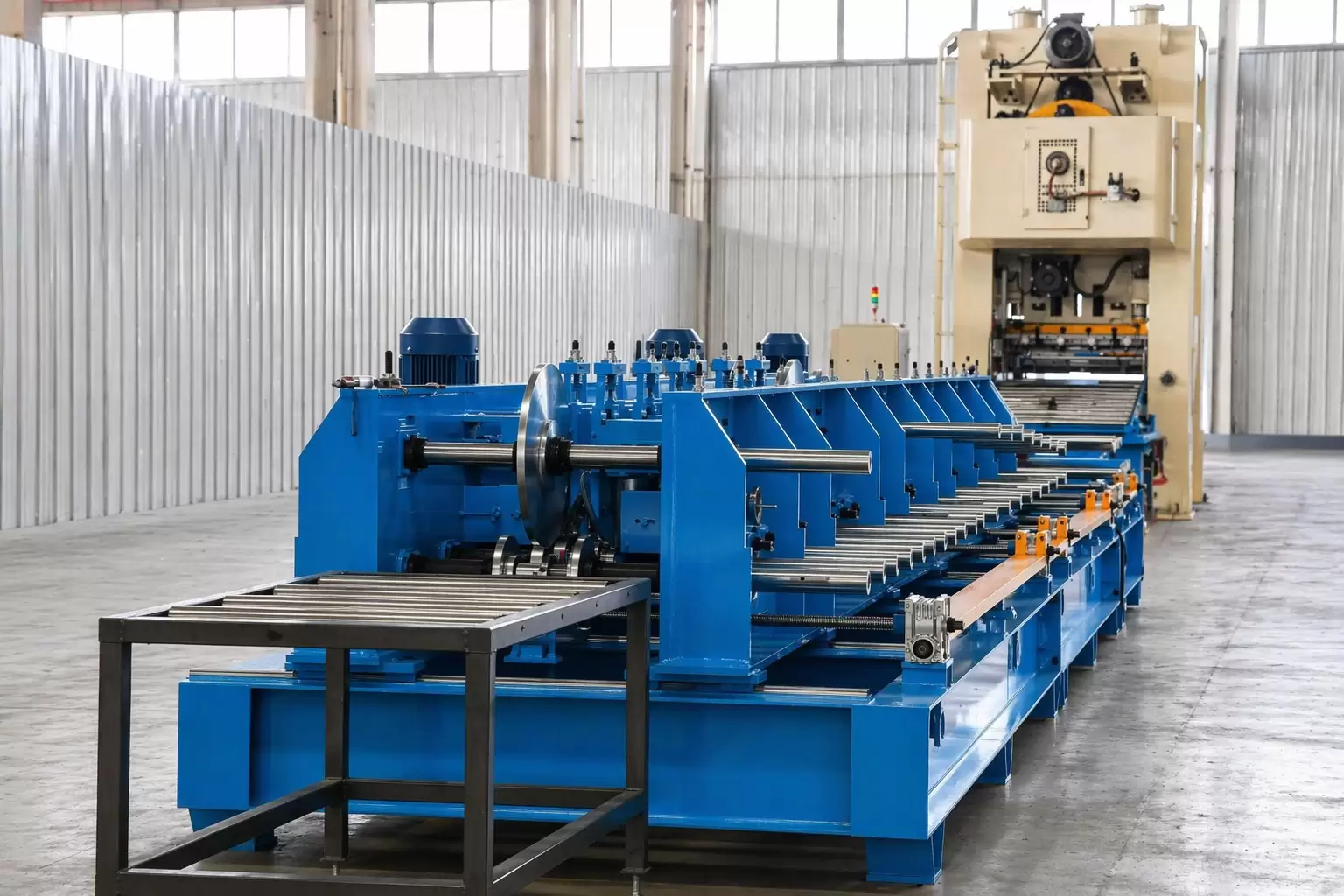
A roll forming machine is a capital investment. Before signing a purchase order, every serious buyer asks the same question: when does this machine pay for itself — and what does it return after that?
The answer is not a guess. It is a calculation. This guide gives you the exact framework to calculate ROI for a roll forming machine investment, with a worked example you can adapt to your own numbers.
Why ROI Calculation Matters Before You Buy
Most buyers focus on the machine price. The better question is: what does the machine cost per meter of profile produced over its operational life — and how does that compare to your current cost of buying finished profiles from an external supplier?
A machine that costs $80,000 and saves you $60,000 per year in material and labor costs pays back in 16 months. A machine that costs $80,000 and only saves $15,000 per year takes over five years to recover — and may not be the right investment at your current production volume.
The ROI calculation tells you which scenario you are actually in.
The Four Cost Components to Model
A complete ROI model for a roll forming machine has four components:
1. Total Investment Cost (TIC)
Everything you spend to get the machine running:
- Machine purchase price
- Freight and import duties
- Foundation and installation costs
- Electrical connection and utility upgrades
- Initial roller tooling (if not included in machine price)
- Commissioning and operator training
- First inventory of spare parts
Formula:
TIC = Machine Price + Freight + Duties + Installation + Tooling + Training + Initial Spares
2. Annual Operating Cost (AOC)
What it costs to run the machine each year:
- Direct labor (operator wages × hours operated)
- Raw material (steel coil cost per tonne × annual consumption)
- Energy consumption (kW × operating hours × electricity rate)
- Maintenance and consumables (lubricants, tooling wear, spare parts)
- Depreciation (machine value ÷ useful life in years)
- Financing cost (if purchased on credit — annual interest)
Formula:
AOC = Labor + Material + Energy + Maintenance + Depreciation + Financing
3. Annual Revenue (or Cost Savings)
Two ways to model this, depending on whether you are a profile manufacturer (selling to customers) or a downstream manufacturer (consuming profiles in your own production):
For profile manufacturers (selling output):
Annual Revenue = Volume produced (meters/year) × Selling price per meter
For downstream manufacturers (replacing purchased profiles):
Annual Savings = Volume consumed (meters/year) × (External purchase price per meter − In-house cost per meter)
4. Annual Net Benefit
Annual Net Benefit = Annual Revenue (or Savings) − Annual Operating Cost
The Key Metrics: Payback Period and ROI
Once you have the four components, two metrics tell you whether the investment makes sense:
Payback Period:
Payback Period (years) = Total Investment Cost ÷ Annual Net Benefit
A payback period under 3 years is generally considered strong for manufacturing equipment. Under 2 years is excellent. Over 5 years warrants careful scrutiny.
Return on Investment (ROI):
ROI (%) = (Annual Net Benefit ÷ Total Investment Cost) × 100
An ROI above 25% per year is solid for capital equipment. Above 50% per year is exceptional.
Worked Example: Cable Tray Roll Forming Machine
Let us walk through a realistic example. A manufacturer in Southeast Asia currently buys finished cable tray profiles from a local distributor and wants to evaluate whether to produce in-house.
Scenario:
- Annual consumption: 500,000 meters of perforated cable tray profile
- Current external purchase price: $2.80 per meter
- Machine under consideration: perforated cable tray roll forming line
Step 1: Calculate Total Investment Cost
Step 2: Calculate Annual Operating Cost
Step 3: Calculate Annual Revenue / Savings
In-house cost per meter:
$101,980 ÷ 500,000 meters = $0.204 per meter
External purchase price: $2.80 per meter
Annual savings:
500,000 m × ($2.80 − $0.204) = 500,000 × $2.596 = $1,298,000 per year
Step 4: Calculate Payback and ROI
Payback Period = $80,000 ÷ $1,298,000 = 0.06 years = less than 1 month
ROI = ($1,298,000 ÷ $80,000) × 100 = 1,622% per year
Interpretation: In this scenario — high volume consumption replacing expensive external purchases — the machine pays back almost immediately. This is the most favorable scenario for roll forming investment: when you are currently buying profiles at a large margin above what it costs to produce them.
A More Conservative Example: New Market Entry
Not all scenarios are this clear-cut. Here is a more conservative case: a new manufacturer entering the cable tray market, building a customer base from zero.
Scenario:
- Year 1 production volume: 150,000 meters (building customer base)
- Year 2+ production volume: 350,000 meters (at capacity)
- Selling price: $1.80 per meter (competitive market pricing)
- Machine investment: $80,000 (same as above)
Year 1 financials:
Year 2+ financials:
Payback period:
$80,000 ÷ $212,000 = 0.38 years (approximately 4.5 months)
Even in this more conservative new-entry scenario, the machine pays back within half a year. At Year 2 production levels, the annual ROI exceeds 600%.
The Variables That Move the Numbers Most
Understanding which inputs have the biggest impact on ROI helps you identify where to focus your due diligence:
1. Production Volume Volume is the dominant variable. Below a minimum threshold — typically 80,000–120,000 meters per year for a standard cable tray or solar bracket line — the fixed costs (depreciation, labor, energy) make in-house production uncompetitive against purchasing. Above this threshold, every additional meter of production increases ROI at an accelerating rate.
2. Selling Price vs. In-House Cost Gap The larger the margin between your selling price (or external purchase price) and your in-house production cost, the faster the payback. This margin is primarily determined by your raw material procurement cost and the efficiency of your production operation.
3. Machine Utilization Rate A machine running two shifts per day recovers its investment twice as fast as the same machine running one shift. Model your ROI at realistic utilization — not theoretical maximum capacity.
4. Raw Material Cost Steel coil price is the largest single operating cost component. A 10% increase in coil price reduces your annual net benefit by a corresponding amount. Model your ROI at current steel prices and stress-test it at 15–20% higher to confirm the investment still makes sense under adverse material cost conditions.
5. Financing Cost If you are financing the machine purchase rather than paying cash, add the annual interest cost to your operating cost. On an $80,000 machine at 8% annual interest, this adds $6,400 per year — meaningful for a low-volume operation, negligible for a high-volume one.
ROI Calculation Template
Use this template with your own numbers:
When the Numbers Do Not Work
If your ROI calculation produces a payback period exceeding 4–5 years, one of three things is likely true:
Volume is too low. The machine is right for your product, but your current order book does not justify the investment. Consider whether you can secure forward contracts or commitments before purchasing.
The price gap is too small. If external purchase prices are very low — perhaps because a large local competitor has scale advantages — in-house production may not be cost-competitive at your volume. Do not invest to compete on price you cannot win.
The machine is over-specified. A high-speed servo-driven machine with automatic punching may be the right long-term investment but the wrong short-term one. A simpler, lower-cost machine might produce an acceptable ROI at current volumes, with the option to upgrade later.
A negative or marginal ROI calculation is not a failure — it is valuable information that prevents a costly mistake.
Frequently Asked Questions
What is a typical payback period for a roll forming machine? For manufacturers replacing external profile purchases at meaningful volume, payback periods of 3–12 months are common. For new market entrants building volume from zero, 12–24 months is more typical. The range is wide because volume and price gap vary enormously by product and market.
Should I include tooling cost in the ROI calculation? Yes — always. Initial roller tooling is a significant cost (typically $15,000–$40,000 for a standard profile machine) and is part of the capital investment that must be recovered before the machine generates positive ROI.
How do I account for machine downtime in the ROI model? Use a realistic availability factor — typically 85–90% for a well-maintained machine — when calculating annual production volume. Modeling at 100% utilization overstates revenue and understates payback period.
Conclusion
ROI calculation for a roll forming machine is not complicated — it is arithmetic applied to realistic inputs. The output tells you whether and when the investment makes financial sense, which variables matter most, and where your assumptions carry the most risk.
Do the calculation before you buy. Update it with actual numbers after the first three months of production. Use the gap between projected and actual to improve your model for the next investment decision.
If you would like help running the numbers for your specific product, volume, and market — contact our engineering team. We regularly help buyers build realistic ROI models as part of the pre-purchase process.
Related Articles:
