
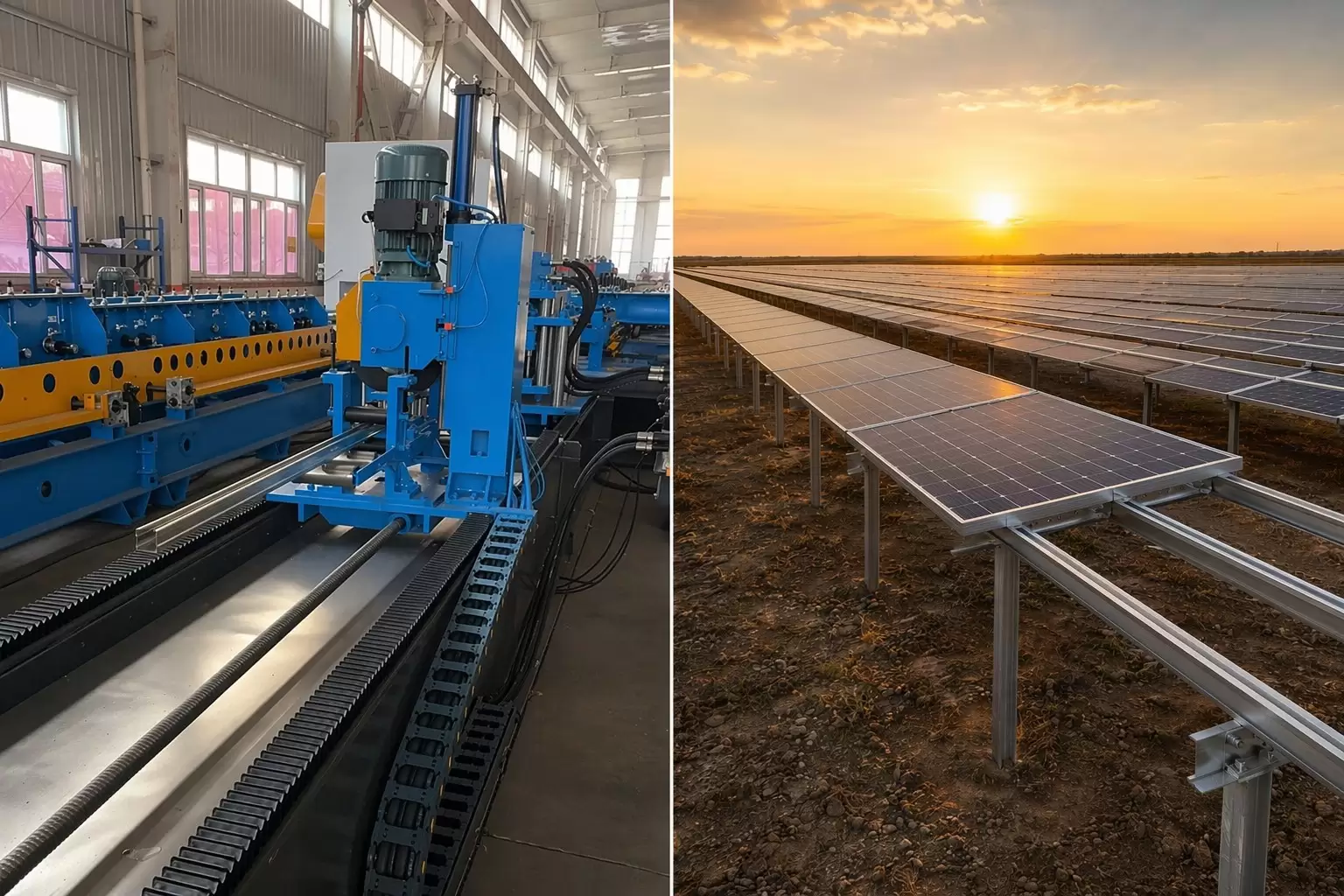
The global roll forming machine market, valued at approximately $5.9 billion in 2026, is forecast to reach $8.6 billion by 2035 at a CAGR of 4.4%. But aggregate market size numbers tell only part of the story. The more important question for manufacturers and buyers is: what is changing about the technology, the end markets, and the competitive landscape — and what does that mean for investment decisions in 2026 and 2027?
This article examines the six most significant trends shaping the roll forming machine industry heading into 2027.
Trend 1: Servo Drive Displacement of Hydraulics
The shift from hydraulic drive systems to servo motor drive systems is the most significant technology transition in roll forming machine design of the past decade — and it is accelerating.
Why it is happening:
- Servo systems reduce energy consumption by 35–55% compared to hydraulic at equivalent output
- Servo systems provide precise speed control that improves profile dimensional consistency
- Servo punch presses achieve significantly higher speeds and accuracy than hydraulic punch presses
- Servo systems have fewer fluid-based failure modes — no hydraulic oil leaks, no pump wear, no filter clogging
Where it stands in 2026: Servo punch presses are now the market standard for cable tray, strut channel, and solar bracket lines above 15 m/min. Hydraulic punch presses remain competitive at entry-level volumes and simple profiles. Servo-driven main forming mill drives are becoming standard on mid-range and above machines.
What to watch in 2027: The price gap between servo and hydraulic systems is narrowing as servo drive component costs decline. By 2027, servo-equipped machines will be cost-competitive with hydraulic at lower volume thresholds than today, accelerating the technology transition.
Trend 2: Solar and Renewable Energy Driving Volume Growth
Solar energy installation is growing at 20%+ CAGR globally. Behind this growth is a structural demand for roll-formed solar mounting profiles — C-channels, Z-purlins, strut channels, and custom solar rails — that shows no sign of decelerating.
Market data:
- Global solar capacity additions exceeded 450 GW in 2024 and are projected to exceed 700 GW by 2027
- Each GW of utility-scale ground-mount solar requires approximately 3,000–5,000 tonnes of mounting structure
- At 700 GW annual additions, global solar mounting structure demand exceeds 2 million tonnes per year
Manufacturing implication: Solar mounting profile manufacturers who invested in high-speed servo-punching lines in 2024–2025 are running at or near capacity. New investment in dedicated solar channel lines — particularly aluminum-capable lines for coastal and European markets — is accelerating.
What to watch in 2027: The shift from galvanized steel to aluminum solar mounting structures in emerging markets (Southeast Asia coastal, Middle East) will accelerate as aluminum coil supply chains develop and the corrosion maintenance cost of galvanized steel in salt-fog environments becomes better documented.
Trend 3: Automation and Reduced Labor Dependency
Labor cost inflation in China, Southeast Asia, and Latin America is driving investment in more highly automated roll forming lines — machines that reduce the operator count required per line and standardize output quality without operator skill variation.
Technologies being integrated:
- Automatic coil loading cars — hydraulically-powered coil transfer systems that load coils onto the decoiler without crane or forklift intervention
- Automatic stackers — servo-driven stacking systems that sort, count, and palletize finished profiles without manual handling
- Vision system quality control — camera-based systems that inspect hole position, surface quality, and profile geometry at production speed, flagging defects without stopping the line
- Automatic width adjustment — servo-driven side rail adjustment that repositions all rollers simultaneously when a new profile width is programmed at the HMI
What to watch in 2027: Vision-based quality control integration into mid-range (not just premium) cable tray and solar channel lines. As camera and AI processing hardware costs decline, this capability is moving from $250,000 premium lines to $80,000–$120,000 standard lines.
Trend 4: High-Strength Steel Capability Expanding
Advanced high-strength steel (AHSS) and ultra-high-strength steel (UHSS) with yield strengths of 600–1,200 MPa are increasingly specified in automotive structural components, construction connections, and seismic-rated racking systems. Processing these materials requires heavier machine frames, larger shaft diameters, more robust drive systems, and specially designed roller tooling with higher springback compensation.
Market context: Automotive structural roll forming — door reinforcements, roof rails, bumper beams — has been the primary driver of AHSS processing capability development. This capability is now diffusing into construction racking and solar structure applications where seismic design requirements push specifications toward higher-strength materials.
What to watch in 2027: Racking manufacturers in seismic zones (Japan, Taiwan, New Zealand, Western US, parts of Southeast Asia and Middle East) will increasingly specify 550–700 MPa high-strength steel for upright columns to reduce section weight while maintaining load capacity. Machine suppliers who can demonstrate AHSS processing capability with documented springback compensation results will have competitive advantage in these markets.
Trend 5: Modular Machine Architecture
Traditional roll forming machines are monolithic — the decoiler, leveling unit, punch press, forming mill, and cutoff are integrated into one production line that cannot easily be reconfigured or upgraded. Modular machine architecture — where each functional unit is a self-contained module that can be added, removed, or upgraded independently — is gaining traction among manufacturers who need production flexibility.
Benefits of modular design:
- Start with the basic configuration (decoiler + leveling + forming + cutoff) and add punch press module when order volume justifies it
- Upgrade from hydraulic punch to servo punch by replacing the punch module without replacing the entire line
- Add a second forming mill module to handle a second profile family without purchasing a complete new machine
What to watch in 2027: Modular architecture is currently available from a small number of suppliers at a premium. As the concept gains market acceptance, more manufacturers will adopt it — and the price premium over monolithic lines will compress.
Trend 6: China Export Quality Convergence
Chinese roll forming machine exports have historically competed primarily on price. This is changing. A cohort of Chinese manufacturers — primarily those who have invested in CNC tooling equipment, simulation software, and engineering talent — are producing machines that meet or approach European quality standards at significantly lower prices.
What is driving convergence:
- CNC grinding and turning equipment is now widely accessible in China at competitive cost
- Roll forming simulation software (COPRA, Profil) is used by a growing number of Chinese tooling manufacturers
- Experienced engineers trained by European and Japanese machinery companies have returned to Chinese manufacturers
- Export market quality requirements — particularly from Middle Eastern and Southeast Asian EPC contractors — are raising the bar
What this means for buyers in 2027: The quality gap between Chinese and European roll forming machines is narrowing at the mid-range segment. Buyers should still conduct rigorous due diligence (tooling specification, FAT, after-sales support) — but dismissing Chinese suppliers on the basis of assumed quality inferiority is increasingly an error that costs money.
What this means for non-Chinese manufacturers: Competing on price alone against Chinese manufacturers is increasingly unviable. Competing on application engineering depth, after-sales support quality, tooling warranty, and certified load performance data is the sustainable differentiation strategy.
Summary: What to Watch in 2027
Conclusion
The roll forming machine industry entering 2027 is characterized by technology advancement (servo, automation, simulation), market demand growth (solar, data centers, logistics), and competitive landscape evolution (China quality convergence). Buyers who understand these trends will make better investment decisions — specifying machines that match not only today's production requirements but the direction the market is moving.
If you are planning a roll forming machine investment for 2026 or 2027, contact our engineering team for a configuration discussion that incorporates current technology and market trends.
Related Articles:
