
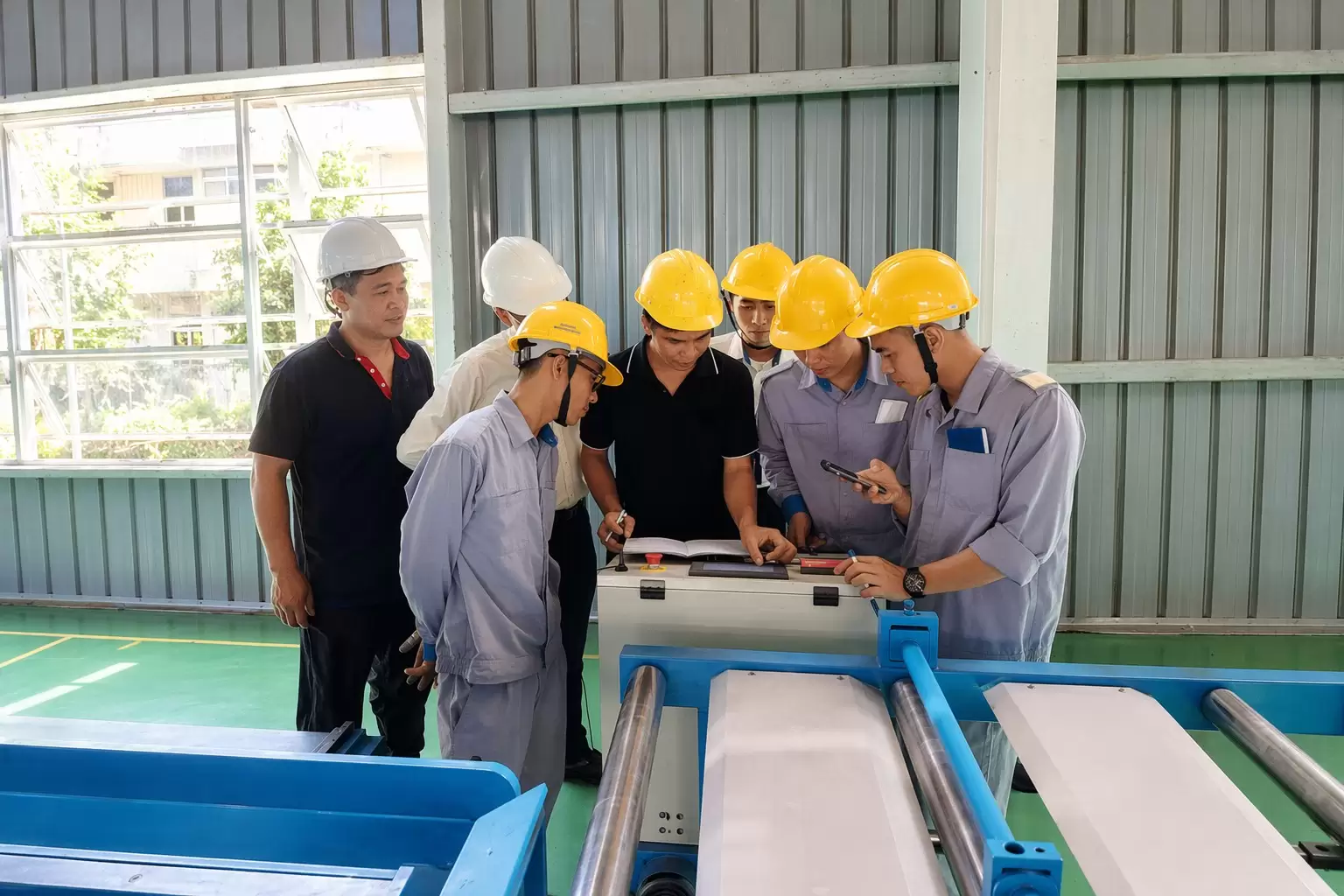
The end of the production year is the best opportunity to do the maintenance work that cannot be done during regular production — a full machine inspection, tooling audit, PLC backup, and bearing replacement based on running hours rather than failure. Factories that complete a structured year-end maintenance program start the new year running reliably. Factories that skip it discover their deferred maintenance costs in the form of emergency breakdowns in Q1.
This checklist covers everything your roll forming equipment needs before the end of the year — organized by machine system so you can assign tasks to the right technicians and track completion.
Why Year-End Is the Right Time
Year-end typically aligns with production slowdowns, holiday shutdowns, or scheduled factory closure. This gives you 2–7 days of uninterrupted machine access — more than enough to complete work that would take weeks if scheduled around production.
The tasks below are organized into three categories:
- Must-do: Critical tasks that prevent breakdown or major quality problems
- Should-do: Important tasks that extend machine life and maintain accuracy
- Nice-to-do: Beneficial improvements that can be deferred if time is short
Section 1: Roll Forming Mill
Roller Tooling Audit [Must-do]
This is the most important year-end task for any roll forming machine. Roller wear is gradual and invisible until profile dimensions start to drift — by which time significant scrap may have been produced.
Procedure:
- Remove roller sets from each station
- Measure roller diameters at the forming contact surface using a micrometer — record against original dimensions
- Measure roller profile geometry using a profile projector or template gauge
- Compare measurements against the original tooling drawing
- Send rollers showing wear beyond tolerance for reconditioning (re-grinding) — do not wait for in-production failure
Decision threshold: If any roller diameter has reduced by more than 0.3 mm from the original, or if any profile geometry dimension is more than 0.2 mm from nominal, schedule reconditioning.
Document: Create a tooling condition log with station number, roller ID, date measured, and wear status. This becomes your baseline for next year's comparison.
Forming Station Alignment [Should-do]
Over a year of production, thermal cycling and vibration can shift roller stands from their original aligned positions.
Procedure:
- With all tooling removed, use a precision straightedge or laser alignment tool to verify the machine centreline from entry to exit
- Check that all roller stands are at the same height (±0.1 mm) using a precision level
- Re-shim any stands that have settled or shifted
- After re-alignment, reload tooling and verify roller gap settings match the setup sheet
Bearing Inspection and Replacement [Must-do for high-hours stations]
Forming station bearings are typically rated for 20,000–30,000 operating hours. For a machine running 8 hours/day, 250 days/year, that is 2,000 hours/year — bearings in continuous production machines should be inspected annually and replaced proactively before failure.
Procedure:
- Check axial and radial play in each roller shaft bearing using a dial indicator
- Listen for noise during slow-speed rotation after reassembly — grinding, squealing, or irregular noise indicates bearing damage
- Replace any bearing showing measurable play or audible damage
- Replace all bearings in the highest-load stations (typically the last 3–5 forming stations) on a 3-year cycle regardless of apparent condition
Section 2: Punching System
Punch and Die Inspection [Must-do]
Worn punch and die tooling produces excessive burr on hole edges, requires increasing hydraulic pressure, and eventually produces torn rather than cleanly punched holes.
Procedure:
- Remove punch and die set
- Inspect punch face for wear, chipping, or rounding of the cutting edge
- Inspect die clearance hole for bell-mouthing (widening at the top from repeated punching)
- Measure die clearance using feeler gauges — should be 8–10% of material thickness per side
- Have worn punch and die sets resharpened or replaced
Tip: Keep a second punch and die set as a ready spare. Year-end is the right time to send the worn set for reconditioning while production is not running.
Punch Press Hydraulic System [Should-do]
- Drain and replace hydraulic fluid — annual change recommended for punch press systems in continuous operation
- Replace all hydraulic filters (return line, case drain, and suction if fitted)
- Inspect hydraulic hose assemblies for cracking, swelling, or fitting corrosion — replace any suspect hoses
- Check accumulator pre-charge pressure (if fitted) — recharge to specification if low
Section 3: Drive System
Gearbox [Must-do]
- Check gearbox oil level and condition — oil should be clear amber; dark or milky oil indicates contamination or water ingress
- Drain and replace gearbox oil if due (typically every 2,000–4,000 operating hours)
- Clean gearbox breather vent — blocked breathers cause internal pressure buildup and seal failure
- Inspect output shaft seals for leakage — replace any that show seeping oil
Chain Drive [Must-do for chain-drive machines]
- Inspect chain for wear — measure chain elongation using a chain wear gauge; replace if elongation exceeds 2% of nominal pitch
- Check sprocket teeth for wear or hooking — worn sprocket teeth cause accelerated chain wear even on a new chain
- Adjust chain tension to specified deflection
- Lubricate with appropriate chain lubricant — do not use general-purpose grease; it collects debris and accelerates wear
Servo Motors and Drives [Should-do]
- Check servo motor fan filters for dust blockage — clean or replace
- Verify servo drive cooling fan operation — replace fans showing reduced airflow
- Check all motor cable connections for fretting or corrosion at terminals
- Verify encoder cable condition and connector integrity — encoder faults cause speed and position errors
Section 4: Electrical and Control System
PLC Program Backup [Must-do — Critical]
If you have not backed up your PLC program recently, do it now. A control system failure without a backup means weeks of lost production while the program is reconstructed from memory or by the machine supplier — if they still have it.
Procedure:
- Connect laptop to PLC via programming cable or Ethernet
- Upload the full PLC program to the laptop
- Save to two locations: local hard drive and USB drive stored away from the machine
- Record the backup date and the machine parameters (recipe settings, encoder configurations, length calibration values)
Electrical Cabinet [Should-do]
- Turn off main power and lock out
- Inspect all terminal block connections — re-torque any that have loosened (thermal cycling over a year loosens terminal screws)
- Check contactor and relay contact surfaces — replace contactors showing pitting or arcing marks
- Clean dust from cabinet interior using compressed air (outside the cabinet, not inside — compressed air can damage electronics)
- Clean and inspect cabinet cooling fan filters
- Test all safety circuits and emergency stops with power restored — document function test results
Section 5: Mechanical and Structural
Machine Level and Foundation [Should-do]
- Check machine level using a precision level along the centreline and across the width
- Re-shim machine feet if machine has settled more than 0.2 mm from original level
- Inspect foundation anchor bolts — re-torque if any have loosened
- Check for cracks in the factory floor around the machine foundation
Lubrication System [Must-do]
- Drain and flush all centralized lubrication reservoirs
- Refill with fresh lubricant of the correct specification
- Replace lubrication pump filter elements
- Inspect all distribution lines for blockages, cracks, or disconnected fittings
- Manually operate the lubrication system and verify lubricant reaches all distribution points
Year-End Maintenance Completion Checklist
Spare Parts Inventory Review [Nice-to-do]
Year-end is also the right time to review your spare parts inventory and reorder items that are running low:
- Cutoff blade set — minimum 1 spare on hand
- Punch and die set — minimum 1 spare per active hole pattern
- Hydraulic seals — cutoff cylinder and punch cylinder
- Hydraulic filter elements — 6-month supply
- Encoder unit — 1 spare (encoders fail without warning)
- Bearing sets for highest-load stations — 2–3 stations
- PLC I/O modules — 1 of each type installed
- Gearbox oil — enough for one full change
Conclusion
A well-executed year-end maintenance program takes 3–5 days of focused work. It eliminates the most predictable sources of Q1 breakdown, starts the new year with calibrated roller gaps and documented tooling condition, and gives your maintenance team a structured framework they can execute consistently year after year.
The machines that produce reliably for 10–15 years are not exceptional machines — they are ordinary machines that received consistent, structured maintenance. Start 2027 with yours in that condition.
If you need spare parts, tooling reconditioning support, or technical guidance for your year-end maintenance, contact our engineering team.
Related Articles:
