
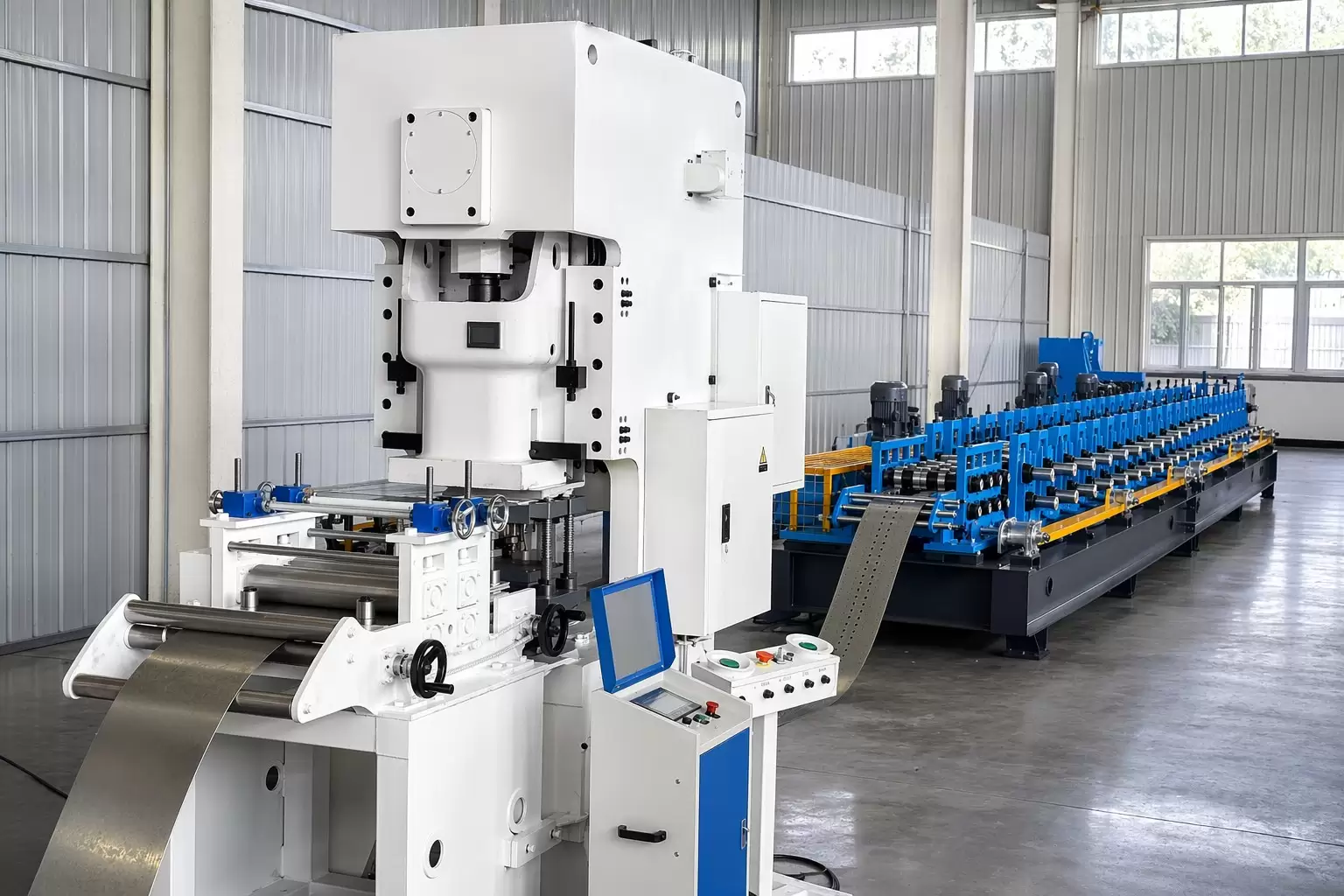
The global warehouse racking market exceeded $9.7 billion in 2024 and continues to expand as e-commerce, cold chain logistics, and automated fulfillment drive demand for higher-density, more sophisticated storage systems. For manufacturers entering or scaling in this market, understanding the full journey from product design to production line investment is the foundation of a viable business plan.
This article covers the complete pathway: racking system types, structural design considerations, component manufacturing requirements, and the production line configuration that supports each.
The Five Main Racking System Types
Different storage applications require different racking configurations. Each type imposes different requirements on the manufacturing process.
1. Selective Pallet Racking (Most Common) Single-deep rows accessible from both sides of each aisle. The dominant system globally — the standard for distribution centers, retail back-of-house, and general warehousing. Components: uprights, step beams, diagonal bracing, base plates. Manufacturing complexity: moderate.
2. Drive-In / Drive-Through Racking Forklifts drive into the rack structure to place or retrieve pallets. High-density storage; sacrifices selectivity for space efficiency. Requires structural uprights capable of lateral forklift impact loads. Manufacturing complexity: higher — heavier gauge, more complex upright geometry.
3. Push-Back Racking Pallets are stored on inclined rails and pushed back as new pallets are loaded. First-in, last-out (FILO) retrieval. Requires precision-formed inclined rail profiles and cart components. Manufacturing complexity: high — custom profiles and tight dimensional tolerances.
4. Cantilever Racking Horizontal arms extend from a central column to store long or irregular items — pipes, lumber, sheet metal. Arms must be precisely formed and welded at the correct angle to the column. Manufacturing complexity: moderate — arm forming and welding precision.
5. Very Narrow Aisle (VNA) Racking High-density racking designed for guided turret truck operation in aisles as narrow as 1.5 meters. Requires the tightest dimensional tolerances of any racking type — upright straightness, beam level, and aisle width all affect the automated truck's ability to operate safely. Manufacturing complexity: highest.
Structural Design: What Determines Component Specification
Before investing in production equipment, the racking manufacturer needs to define the structural specification their products will meet. Three elements drive this:
Load requirements:
- Upright section modulus determines the column's axial and bending load capacity
- Beam section modulus determines the maximum uniform distributed load (UDL) per bay
- Connection shear strength (beam-to-upright) determines the system's ability to resist horizontal loads
Applicable standard:
- EN 15512 (Europe and many developing markets)
- RMI/ANSI MH16.1 (North America)
- AS 4084 (Australia)
- FEM 10.2.02 (international)
Each standard specifies minimum steel grade, connection test methods, and seismic design requirements. The manufacturing process — material grade, forming tolerances, weld quality — must be validated against the applicable standard before the product can be sold into regulated markets.
Seismic zone: In seismic regions (Southeast Asia, Middle East, Latin America), racking must be designed for lateral earthquake loads. This typically means heavier gauge uprights, diagonal bracing in both planes, and floor anchor specifications that affect the base plate design.
Component Manufacturing: The Production Line Requirements
A complete selective pallet racking factory requires three core production lines plus supporting equipment:
Line 1: Upright Roll Forming Line
Produces the vertical columns that form the frame of every bay.
Key specifications:
- Material: 1.5–3.0 mm Q235B or S235JR steel
- Profile: C-section or box section with teardrop or rectangular punch pattern
- Punch pitch: typically 50 mm or 75 mm, accuracy ±0.5 mm
- Forming stations: 18–24
- Line speed: 4–30 m/min (depends on punching system)
- Output: 2,000–6,000 mm uprights, custom heights to 12,000 mm for VNA
The punching system (servo, hydraulic, or rotary) is the key investment decision — see our detailed guide: Pallet Rack Upright Roll Forming Machine: Complete Guide
Line 2: Beam Roll Forming Line
Produces the horizontal load beams that span between uprights.
Key specifications:
- Material: 1.5–2.5 mm cold-rolled or pre-galvanized steel
- Profile: step beam (P-beam) or box beam
- Forming stations: 16–24
- Seam welding: HF (high-frequency) or spot welding
- Output: 900–3,600 mm beams, custom lengths
Companion requirement: end connector welding station to attach the hook tabs that engage the upright's punch pattern.
See detailed guide: Rack Beam & Bracing Roll Forming Machine
Line 3: Bracing Roll Forming Line
Produces the diagonal members that connect upright pairs into rigid frames.
Key specifications:
- Material: 1.5–3.0 mm steel
- Profile: C-section or flat bar
- Critical feature: programmable angle cut (diagonal members must be cut at the frame's diagonal angle, not straight)
- In-line hole punching for connection points
Supporting Equipment
- Powder coating line (or hot-dip galvanizing for outdoor/cold storage)
- Base plate press (punch press + fixture for anchor hole pattern)
- Connector welding fixture (for beam end hook tabs)
- Quality control station (dimensional check, load test, visual inspection)
Production Planning: Matching Line Capacity to Market Demand
A common mistake is purchasing production equipment based on installed capacity rather than actual order volume. Here is a practical framework:
Step 1: Define your target market segment Standard selective racking for general warehousing vs. heavy-duty drive-in for cold storage vs. VNA for automated fulfillment — each has different volume, margin, and production complexity profiles.
Step 2: Estimate annual volume in tonnes Work backward from your sales forecast:
- 1 standard pallet rack bay (2 uprights + 10 beams + 4 bracing members) weighs approximately 80–120 kg
- 10,000 bays/year ≈ 800–1,200 tonnes of finished racking
- This volume requires approximately 1,000–1,500 tonnes of steel coil input (accounting for material losses)
Step 3: Match production line speed to volume
- Upright line at 10 m/min, running 8 hours/day, 250 days/year: approximately 1,200 tonnes/year capacity
- Beam line at 15 m/min, same schedule: approximately 900 tonnes/year capacity
If beam production is the bottleneck, either run the beam line on two shifts or add a second beam line before adding upright capacity.
Step 4: Sequence the investment Most successful racking manufacturers follow this sequence:
- Start with upright line + beam line + external bracing sourcing
- Add bracing line when volume justifies in-house production
- Add powder coating when volume makes external coating economically uncompetitive
- Add automated welding when labor cost per unit exceeds the amortized cost of robotic welding equipment
Quality Standards and Testing
Before your product enters the market, it needs to meet the applicable structural standard. This requires:
Component testing:
- Upright stub column compression test
- Beam bending test (UDL to failure)
- Beam-to-upright connection shear test
System testing:
- Full-scale rack frame test per EN 15512 or RMI MH16.1
- Seismic test (required for seismic zone markets)
Third-party certification: Most major markets require test certification from an accredited laboratory. Budget for testing costs ($15,000–$50,000 depending on scope) when planning your market entry.
Conclusion
Building a warehouse racking production line is a structured process — from defining the structural specification to selecting the component production equipment to achieving market certification. Each step builds on the previous one.
The most important decision is which racking system type to target first. Match your initial production investment to the volume and margin profile of one market segment, prove the production process, then expand.
If you are planning a racking production line and want to discuss upright, beam, or bracing machine configurations for your target product specification, contact our engineering team for a complete line proposal.
Related Articles:
