
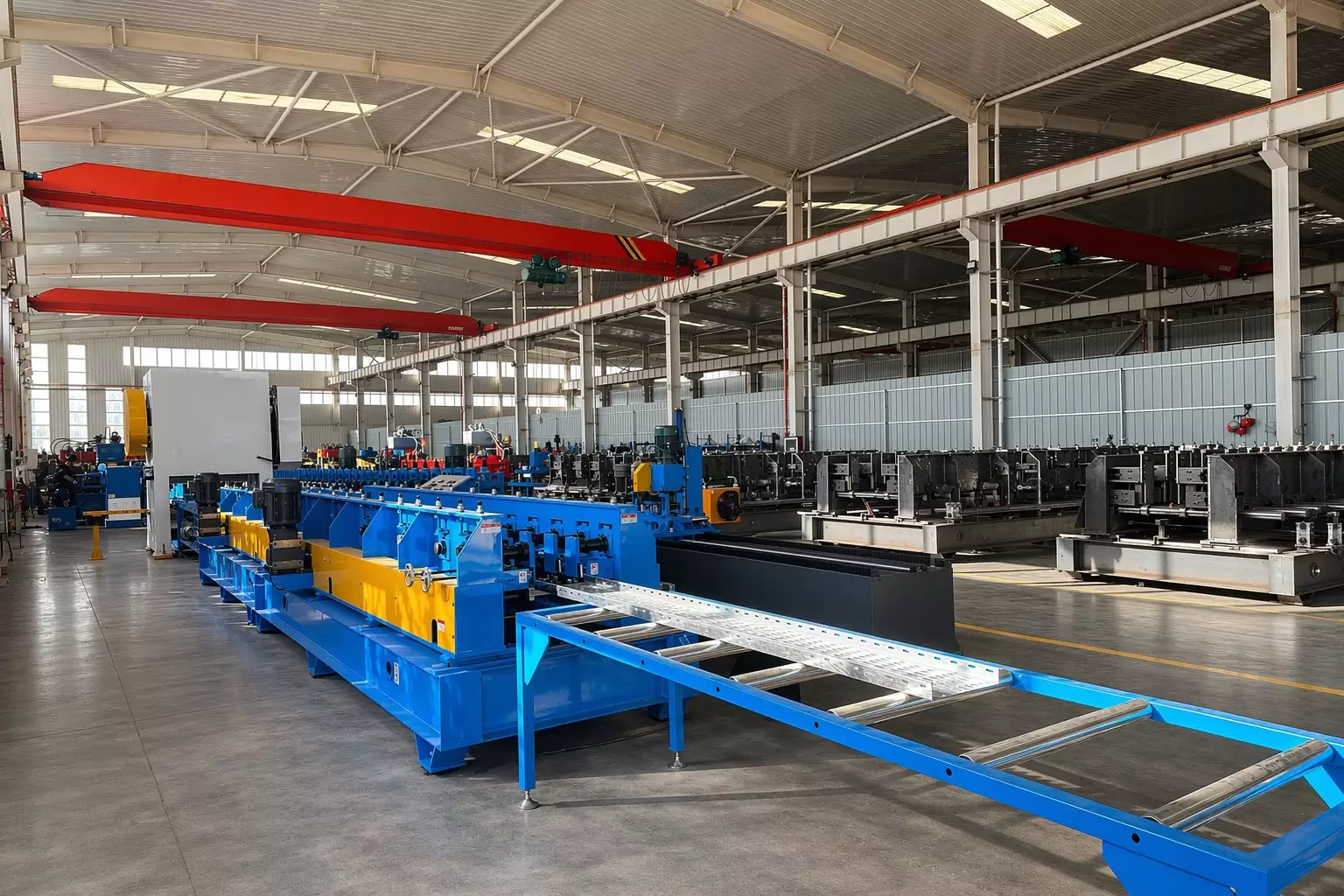
Setting up a cable tray production line is a structured process — one that requires decisions in the right order to avoid expensive mistakes. This guide walks through the complete setup journey: from initial planning through machine selection, factory preparation, installation, and commissioning to first production.
Phase 1: Define Your Production Scope (Weeks 1–2)
Before spending anything, answer four questions:
1. Which cable tray types will you produce? Perforated tray, solid bottom, ladder tray, or all three? Each requires different machine configuration. Ladder tray requires a completely different production process (side rail roll forming + rung welding) from trough-type trays (single-pass roll forming).
2. What tray widths will you produce? Standard market widths range from 50 mm to 600 mm. If you serve multiple widths, you need either multiple fixed-width machines or one adjustable-width machine.
3. What materials will you process? Pre-galvanized steel covers the majority of applications. Stainless steel and aluminum are specialty segments with different machine requirements and higher margins.
4. What is your target annual production volume? This determines required line speed, shift schedule, and whether one machine or multiple machines are needed. Use this formula:
Required line speed = (Annual volume in meters ÷ Operating hours per year) × 1.15 safety factor
Example: 600,000 meters/year ÷ 2,000 hours (single shift) × 1.15 = 345 m/hr = 5.75 m/min. A hydraulic punch machine at 8 m/min is sufficient; a servo machine is not required.
Phase 2: Select the Machine Configuration (Weeks 2–4)
Based on your production scope, define the machine specification:
Companion equipment to include in the initial investment:
- Hydraulic decoiler (3–5 tonnes minimum; 5–8 tonnes recommended)
- 7–9 roller leveling unit
- Output run-out table (minimum 6 meters long)
- PLC control cabinet with HMI touchscreen
- Initial spare parts kit
Optional additions (consider for Year 2):
- Automatic stacker
- Second decoiler for coil pre-loading
- In-line quality measurement system
Phase 3: Factory Preparation (Weeks 4–10, parallel with machine manufacture)
While your machine is being manufactured (45–90 days typical), prepare your factory:
Floor space requirements:
- Full cable tray line including run-out table: 20–35 meters in length × 4–6 meters in width
- Coil storage and handling area: additional 80–120 m²
- Finished product stacking area: additional 100–200 m²
- Minimum ceiling height: 4 meters (for overhead crane if used)
Foundation requirements:
- Standard industrial concrete floor (minimum 150 mm thick, C25 grade) is sufficient for most cable tray machines up to 5 tonnes machine weight
- No special machine foundation required for standard machines
- Anchor bolts: typically 4–8 M20 anchor bolts per machine section
Electrical requirements:
- Three-phase power supply: typically 380V/50Hz (confirm with supplier for your country's standard)
- Main breaker capacity: 100–200A depending on machine power
- Compressed air: 0.5–0.8 MPa, 0.3–0.5 m³/min (for pneumatic components if fitted)
Coil handling:
- Overhead crane (minimum 5-tonne capacity) or forklift with coil ram attachment for loading coils onto decoiler
- Coil storage rack for minimum 10–20 coils
Phase 4: Machine Manufacture and Factory Acceptance Test (Weeks 4–14)
Standard cable tray roll forming machine manufacture: 45–60 days from order confirmation. Servo punch or automatic-width-adjustment machines: 60–90 days.
During manufacture, maintain regular contact with your supplier:
- Week 2: confirm roller tooling design drawing — verify against your profile specification before machining begins
- Week 6: request photos of roller tooling completed and frame structure
- Week 8 (standard) or Week 10 (custom): factory acceptance test
Factory acceptance test checklist:
- Profile width and depth measured at 5 points along 4-meter sample — within ±0.3 mm
- Hole position accuracy over 10 consecutive holes — within ±0.5 mm
- Cut length accuracy over 10 pieces — within ±1.0 mm
- Tray straightness: ≤1 mm per 2 meters
- Forming speed test at specified production speed — 30-minute continuous run
- All safety circuits and emergency stops tested
- PLC program backup provided on USB drive
Phase 5: Shipping and Import (Weeks 14–20)
From factory-ready to delivered at your factory:
Import documentation required:
- Commercial invoice and packing list
- Bill of lading
- Certificate of origin (for preferential duty rates where applicable)
- Technical documentation (for customs classification)
Duty rates: Vary by country and HS code. Industrial machinery typically attracts 0–15% import duty. Budget for this in your total investment cost.
Phase 6: Installation and Commissioning (Weeks 20–22)
Installation sequence:
- Unpack and position machine sections on factory floor
- Level machine using precision level (all stands within 0.1 mm/meter)
- Align machine centreline from decoiler to run-out table
- Connect electrical power and test all circuits
- Load PLC program and verify parameter settings
- Load test coil and run slow-speed commissioning run
Supplier engineer on-site: 7–10 days standard for a cable tray machine. The engineer should not leave until the machine is producing profiles within tolerance from your actual production material (not the engineer's test coil).
Operator training (during commissioning):
- Machine startup and shutdown procedure
- Coil loading and threading
- Profile changeover procedure (if adjustable-width)
- Basic fault diagnosis and reset
- Daily maintenance tasks
Total Investment Summary
The wide range reflects the difference between a basic fixed-width hydraulic machine (lower end) and a high-speed servo adjustable-width stainless/aluminum capable line (upper end).
Timeline Summary
Conclusion
Setting up a cable tray production line takes 4–6 months from initial planning to first production — less if the machine is a standard configuration and your factory is already prepared. The largest variable is machine specification complexity: a standard hydraulic machine ships faster and installs more simply than a servo-driven automatic-width-adjustment line.
Plan the factory preparation in parallel with machine manufacture to minimize total elapsed time. Insist on a factory acceptance test before shipment. And ensure the commissioning engineer stays on-site until the machine is producing to specification with your production material.
If you want a detailed configuration recommendation and timeline for your specific cable tray product range and production volume, contact our engineering team.
Related Articles:
, and 15–22 week timeline from order to production.)