
Every year, manufacturers lose tens of thousands of dollars — sometimes more — on roll forming machine purchases that do not deliver what was expected. The machine arrives, and then: the profile does not hold tolerance, the punching system cannot handle the required volume, the control system requires software support that is not available locally, or the supplier goes quiet after payment clears.
These are not random bad luck. They are predictable mistakes with identifiable causes. This article covers the five most common — and most expensive — errors buyers make, and exactly how to avoid each one.
Mistake 1: Buying on Price Without Understanding Total Cost of Ownership
The most common mistake in roll forming machine purchasing is selecting the lowest-price supplier without modeling the full cost of ownership over the machine's operational life.
A machine quoted at $55,000 versus $80,000 looks like a $25,000 saving. Over five years of production, the picture is often completely different:
The "cheap" machine costs $28,000 more over five years — and this calculation does not include contract penalties from customer complaints about out-of-tolerance profiles.
The fix: Build a 5-year total cost model before comparing prices. Include tooling life, estimated downtime, scrap rate, and support costs. Compare that number, not the purchase price.
Mistake 2: Under-Specifying the Punching System
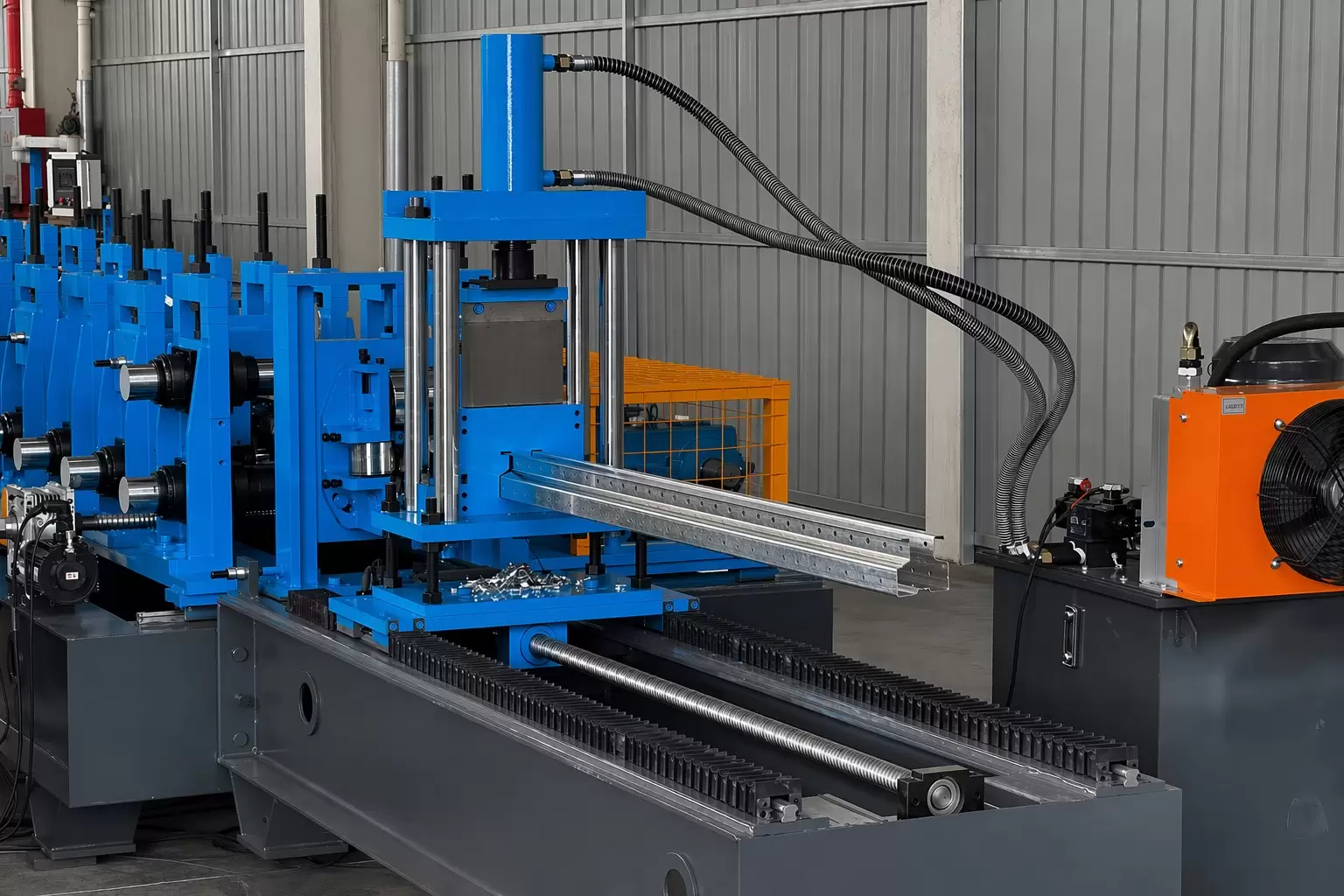
For machines that produce perforated profiles — cable trays, rack uprights, solar channels, strut channels — the punching system is the machine's most critical component. It is also the component buyers most frequently under-specify.
The mistake typically goes like this: the buyer needs a cable tray machine, gets a quote for a hydraulic punch press (the cheapest option), and finds that at 5 m/min effective speed, the machine cannot meet their production volume targets. Upgrading to a servo punch press after delivery costs 40–60% more than specifying it correctly upfront.
Common under-specifications:
The fix: Calculate your required production output in meters per shift. Divide by effective forming speed (not nameplate speed — account for loading, changeovers, and maintenance). If the number does not close with a hydraulic punch, specify servo or rotary upfront. The price difference is always less than the cost of retrofitting.
Mistake 3: Not Securing the Profile Specification in Writing Before Tooling Is Cut
Roll forming tooling is custom-manufactured for each profile. Once the tooling is cut, it produces one cross-section. If the cross-section is wrong — because the drawing was ambiguous, because a dimension was misunderstood, or because the supplier assumed a standard where you needed a custom — re-cutting the tooling costs $8,000–$25,000 and adds 3–6 weeks to your delivery.
This mistake happens in two variations:
Variation A: The buyer provides a reference sample without a dimensioned drawing. The supplier reverse-engineers the profile, but their interpretation differs from the buyer's expectation in key dimensions or tolerances.
Variation B: The buyer provides a drawing, but it lacks tolerances. The supplier produces a profile that matches the drawing's nominal dimensions, but the actual tolerance on the cross-section width is ±2 mm when the buyer's customer requires ±0.5 mm.
The fix:
- Provide a fully dimensioned CAD drawing with explicit tolerances on every critical dimension
- Confirm in writing that the supplier will produce tooling to your drawing — not a "standard" equivalent
- Require a profile dimensional measurement report from the factory acceptance test before shipment
- If the FAT results show any dimension outside tolerance, require tooling correction before accepting the machine
Mistake 4: Skipping the Factory Acceptance Test
The factory acceptance test (FAT) is the quality gate between manufacturing and shipment. Skipping it — or accepting a watered-down version — is the single most expensive shortcut buyers take.
Why buyers skip the FAT:
- "We trust the supplier" — trust is not a substitute for measurement
- "It adds cost to fly someone there" — the cost of flying to China is a fraction of the cost of shipping back a non-conforming machine
- "We can test it after delivery" — testing after delivery means production delay, return shipping cost, and months of dispute
What a proper FAT catches:
- Profile dimensions outside tolerance
- Hole position accuracy outside specification
- Length measurement accuracy drift
- Electrical faults in sensors, limit switches, or safety circuits
- PLC parameter errors that cause incorrect production behavior
The fix: If you cannot attend in person, require a live video FAT with digital measurement instruments shown on camera, and a written test report emailed before you authorize shipment. This is a minimum non-negotiable condition in your purchase contract — not a nice-to-have.
Mistake 5: Not Confirming Local After-Sales Support Before Buying
A roll forming machine is a complex electromechanical system. It will eventually need troubleshooting support, spare parts, or software modification. If your supplier's after-sales response is a WhatsApp message answered 12 hours later by someone who cannot diagnose a PLC fault, you have a problem.
This mistake is especially common for buyers in Southeast Asia, the Middle East, Africa, and Latin America — markets where many Chinese suppliers have sold machines but few have established genuine local support capability.
Questions to ask before buying:
- Do you have a service engineer or local agent in my country?
- What is your guaranteed response time for technical support requests?
- What is your average spare parts delivery time to my country?
- Is your PLC program open (not password-locked), so my local electrician can diagnose faults?
- Can I speak to a previous customer in my region about their after-sales experience?
The fix: Choose a supplier who can provide verifiable local support references — not just promises. And include after-sales response time commitments in the purchase contract, with consequences for non-performance.
The Bonus Mistake: Buying More Machine Than You Currently Need
This is not the most expensive mistake, but it is common: buying a high-speed, fully automated machine for a production volume that does not yet justify it.
A manufacturer producing 100,000 meters per year does not need a $200,000 servo-punching, automatic-width-adjustment line. A $65,000 hydraulic-punch fixed-width machine will serve them well and pay back in 18 months. The high-spec machine pays back in 6 years at that volume — if ever.
The fix: Match the machine specification to your current confirmed order volume, with a clear upgrade path when volume grows. Most roll forming machines can be upgraded with additional tooling sets, servo drive retrofits, or punching system upgrades — buying the base machine right and upgrading later is usually more economical than buying full-spec upfront for volume you have not yet achieved.
Conclusion
The five mistakes covered here — buying on price alone, under-specifying punching, vague profile specification, skipping the FAT, and inadequate after-sales support — account for the majority of expensive roll forming machine disappointments. None of them require specialized knowledge to avoid. They require structured due diligence and contractual discipline.
If you want a supplier who will answer all of the questions in this article directly, provide verifiable references, and document everything in the purchase contract — contact our engineering team. We have sold machines to buyers in over 80 countries and welcome buyers who ask hard questions.
Related Articles:
