
A roll forming machine quotation lists dozens of specifications — forming stations, motor power, shaft diameter, roller material, forming speed, cutting accuracy. Some of these specifications are critical to your production outcome. Others are secondary. And a few are marketing numbers that tell you very little about real performance.
This guide explains every major roll forming machine specification, what it actually means for production, and which ones to prioritize when comparing suppliers.
1. Forming Stations (Roll Stands)
What it is: The number of paired roller stations in the forming mill. Each station bends the material a small amount further toward the final profile shape.
What it means: More stations allow shallower bending angles per station, which reduces material stress, improves dimensional accuracy, and is required for complex profiles or difficult materials (aluminum, high-strength steel).
Typical values:
- Simple profiles (C-channel, angle): 8–14 stations
- Standard profiles (strut channel, purlin, cable tray): 14–20 stations
- Complex profiles (rack upright, guardrail, step beam): 18–28 stations
What to watch for: A machine with too few stations for your profile complexity will produce bow, twist, or surface cracking. A machine with more stations than needed costs more but produces better quality. When in doubt, more stations is safer.
2. Roller Material and Hardness
What it is: The alloy and heat treatment of the forming rollers.
What it means: Roller hardness determines wear resistance under forming load. Harder, tougher rollers last longer and maintain profile accuracy over more production cycles.
Standard specification:
- Cr12MoV alloy tool steel, HRC 58–62: Industry standard for production machines. Provides 5–10 years of service life on standard galvanized steel. Required for high-strength steel and stainless processing.
- GCr15 bearing steel, HRC 58–62: Acceptable for light-duty, low-speed applications. Wears faster than Cr12MoV under continuous production loads.
- D2 / SKD11 (equivalent to Cr12MoV): European designation for the same alloy family.
What to prioritize: Require Cr12MoV or equivalent in writing. Do not accept "high-quality alloy steel" without the specific grade designation. This is the single specification with the largest impact on long-term tooling cost.
3. Shaft Diameter
What it is: The diameter of the drive shafts on which forming rollers are mounted.
What it means: Shaft diameter determines the shaft's resistance to deflection under forming load. A shaft that deflects under load causes the roller gap to vary across the strip width — producing a profile that is wider or narrower on one side than the other.
Typical values by application:
- Light-gauge cable tray, drywall stud (≤1.5 mm): 50–60 mm shafts
- Standard cable tray, strut channel (1.5–2.5 mm): 60–75 mm shafts
- Rack upright, solar bracket (1.5–3.0 mm): 70–80 mm shafts
- Guardrail, heavy structural (2.5–4.0 mm): 80–100 mm shafts
Shaft material: 42CrMo (SCM440) quenched and tempered is the standard. Verify this — plain carbon steel shafts are significantly weaker and will deflect under load.
4. Forming Speed
What it is: The linear speed at which the metal strip passes through the forming mill, measured in meters per minute (m/min).
What it means for production: Forming speed directly determines your output in meters per hour. However, the effective production rate also depends on loading time, changeovers, and — critically — the speed limitation imposed by your punching system.
Typical values:
- Basic hydraulic-punch machines: 5–15 m/min effective speed (punch-limited)
- Servo-punch machines: 15–25 m/min
- Rotary punch or no-punch machines: 25–60 m/min
What to watch for: Suppliers sometimes quote the machine's mechanical speed capability (e.g., 40 m/min) without noting that the integrated punch press limits effective production to 8 m/min. Always ask for the effective production speed with the punch system operating at your required hole pitch.
5. Main Motor Power
What it is: The rated power of the main drive motor(s) that drive the forming rollers, measured in kilowatts (kW).
What it means: Motor power must be sufficient to form your target material at the specified thickness and speed. Underpowered motors overheat and trip during production, causing downtime.
Typical values by application:
What to watch for: Motor power is one of the easiest specifications to inflate on paper. Verify that the stated motor is actually installed by requesting the motor nameplate specification in commissioning photos or the FAT report.
6. Drive System Type
What it is: The mechanism by which motor power is transmitted to the forming roller shafts.
Types:
- Gearbox drive: Motor → gearbox → individual shaft gears. Most robust and reliable for continuous production. Recommended for all machines processing material above 2.0 mm or running more than one shift per day.
- Chain drive: Motor → chain → sprocket on each shaft. Lower cost. Adequate for light-gauge, moderate-speed applications. Requires regular chain tension maintenance; chain stretch causes speed variation.
- Servo direct drive: Individual servo motors drive each shaft or group of shafts. Maximum precision and control; highest cost. Used in premium high-accuracy lines.
What to prioritize: Gearbox drive for any machine processing material above 1.5 mm at production volumes above 200,000 m/year. Chain drive is acceptable for lighter applications with proper maintenance.
7. Cutting Accuracy
What it is: The dimensional tolerance on the finished profile length, measured in millimeters (±mm).
What it means: Cutting accuracy affects assembly quality. For racking systems, cable tray runs, and solar arrays — where profiles must fit together consistently — length variation beyond tolerance causes field installation problems.
Typical values:
- Hydraulic stop-cut: ±1.5–2.0 mm
- Servo-synchronized cutoff: ±0.5–1.0 mm
- Flying saw: ±0.8–1.5 mm
What to prioritize: If your profiles are used in precision assembly systems (racking, solar mounting, data center cable management), require ±1.0 mm or better. For general construction applications, ±1.5 mm is usually acceptable.
8. Decoiler (Uncoiler) Capacity
What it is: The maximum coil weight the decoiler can hold, measured in tonnes.
What it means: Larger coil capacity means fewer coil changes per shift — improving production efficiency. A decoiler that is too small requires frequent coil changes that interrupt production and reduce effective output.
Typical values:
- Light lines (≤1.0 mm material): 3 tonnes
- Standard lines (1.0–2.5 mm): 5 tonnes
- Heavy lines (2.5–4.0 mm, guardrail): 8–10 tonnes
What to watch for: Coil weight and coil width are both specified. A 5-tonne decoiler may accommodate a 5-tonne coil at 300 mm width but cannot accommodate the same weight at 1,200 mm width due to mandrel strength limitations. Confirm both weight and width capacity match your coil dimensions.
9. Frame Structure
What it is: The structural design and material of the machine base frame.
What it means: The frame must be rigid enough that it does not deflect under forming loads — deflection causes the roller gap to vary and the profile to drift out of tolerance over time.
Specifications to look for:
- Heavy-duty welded H-beam or box section steel frame
- Stress-relieved after welding (annealing to remove residual weld stress)
- Minimum wall thickness: 20–30 mm for the main frame members on standard machines
- Vibration isolation: some manufacturers fit vibration-damping pads between the machine and the floor
Red flag: Thin-wall welded tube frame construction. These frames may appear rigid under static load but deflect significantly under dynamic forming loads at production speed.
10. Control System (PLC and HMI)
What it is: The electronic control system that manages machine operation, speed, punching timing, and cutting sequence.
Key specifications:
- PLC brand: Siemens S7-series, Mitsubishi Q/FX-series, Delta DVP/AS-series are the market standards with global service networks
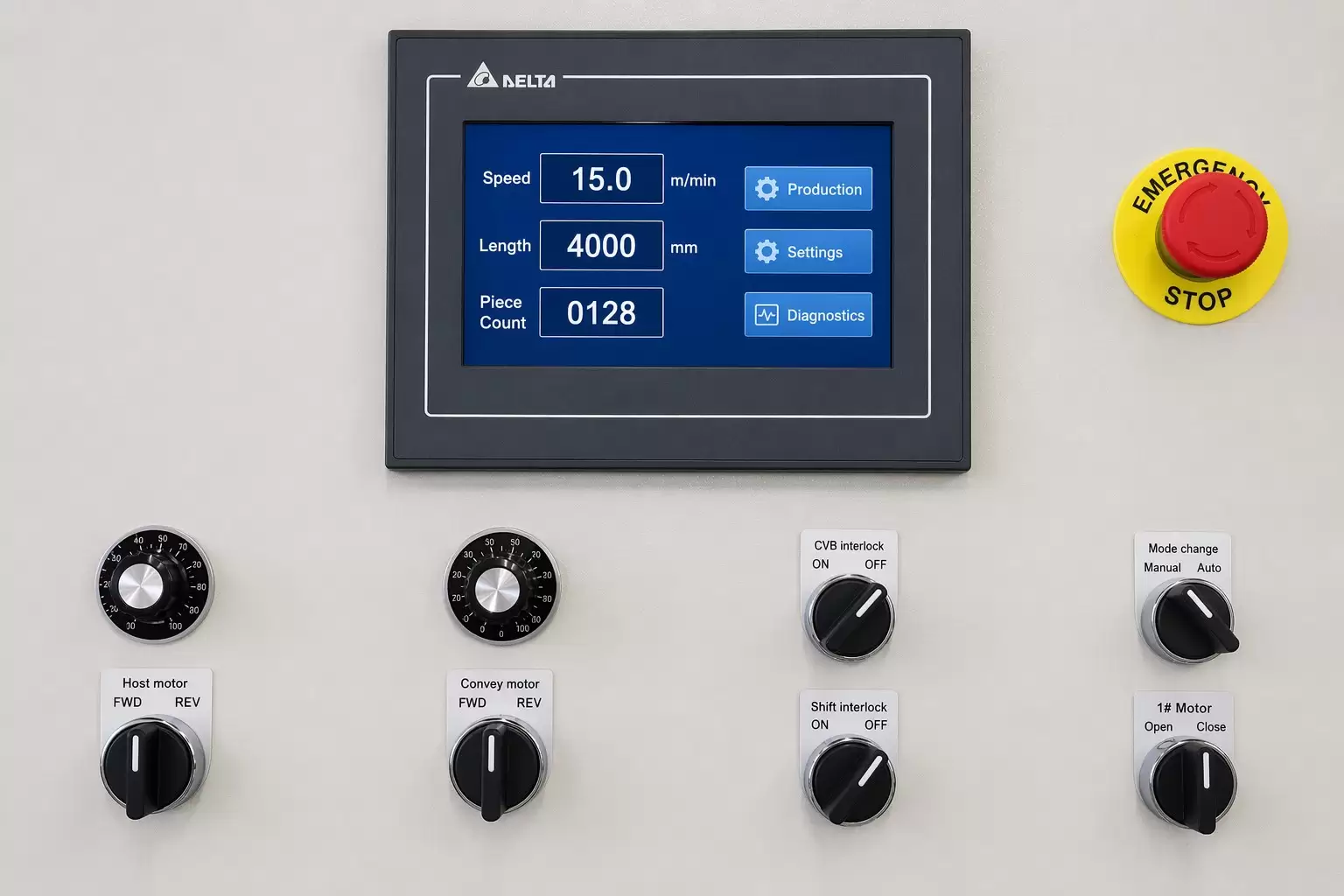
- HMI: 7–15 inch color touchscreen for parameter entry, production count, fault diagnosis
- Recipe storage: Ability to store multiple profile recipes (length, punch pattern, speed) and recall them instantly — critical for multi-product operations
- Remote diagnostics: Ethernet connectivity for remote PLC access by the supplier's engineers (reduces response time for software faults)
- Program access: Confirm the PLC program is NOT password-locked — you must have access to your own machine's control logic
Specification Comparison Checklist
Use this checklist when comparing machine quotations:
Conclusion
Roll forming machine specifications are not marketing language — they are the engineering parameters that determine whether your machine will produce the right profile, at the right speed, with acceptable quality, for the next decade. Prioritize roller material, shaft diameter, effective forming speed, drive system, and cutting accuracy. Require these specifications in writing in the purchase contract, not just in the quotation document.
If you want a specification comparison review for machines you are currently evaluating, contact our engineering team. We will assess the specifications against your production requirements and give you an honest technical opinion.
Related Articles:
