
If you have spent any time in the electrical, mechanical, or solar installation industry, you have encountered both terms: "strut channel" and "Unistrut." They are often used interchangeably — but they are not the same thing, and the distinction matters when you are specifying a roll forming machine to produce them.
This article explains the difference, clarifies the profile specifications involved, and helps you determine which machine configuration your production requirements actually need.
What Is Strut Channel?
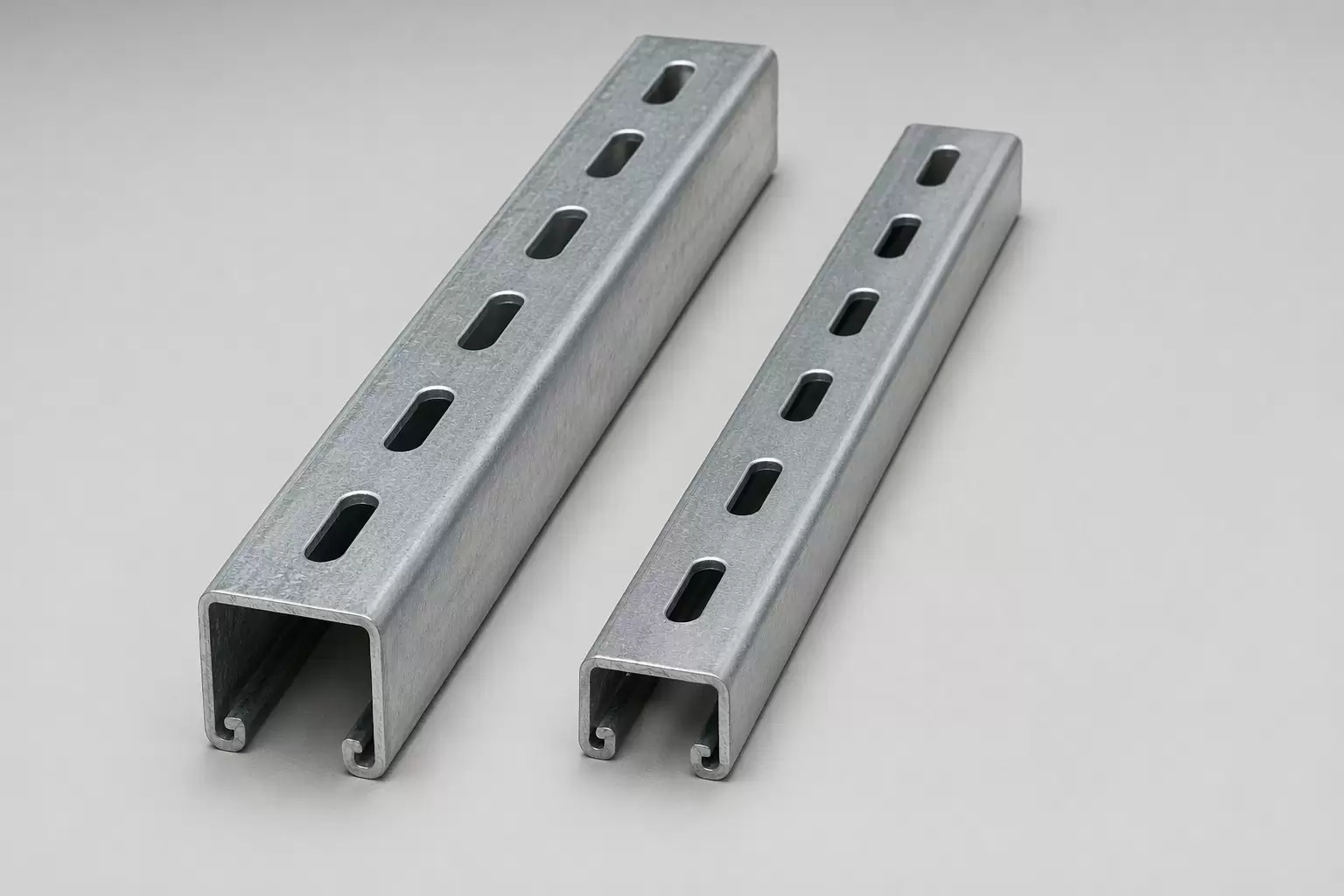
Strut channel is a structural support profile — a U-shaped metal channel with inward-curled lips and a slotted or plain web — used to support pipes, conduit, cable trays, solar panels, and mechanical equipment in electrical and mechanical installations.
It is a product category, not a brand. Any manufacturer can produce strut channel. Galvanized steel strut channel is produced on a roll forming machine, and it is one of the most widely manufactured profiles globally — used in virtually every commercial, industrial, and infrastructure project.
Standard strut channel dimensions:
- 41×41 mm (1-5/8" × 1-5/8") — the global standard
- 41×21 mm (1-5/8" × 13/16") — half-depth / mini channel
- 41×62 mm (1-5/8" × 2-7/16") — deep channel
- 82×41 mm (3-1/4" × 1-5/8") — double channel / back-to-back
What Is Unistrut?
Unistrut is a brand name — specifically, the trademarked name of strut channel manufactured by Unistrut Corporation (now part of Atkore International), originally developed in the 1920s and standardized through decades of US industrial construction.
In North America, "Unistrut" became so widely used as a term for strut channel that it is now used generically — similar to how "Kleenex" is used for tissue paper. When a specification says "Unistrut or equivalent," it means standard 41×41 mm strut channel meeting the dimensional and load requirements of ASTM or equivalent standards.
Unistrut P1000 is the most widely recognized designation — a 1-5/8" × 1-5/8" 12-gauge steel strut channel with a standard slot pattern.
Are They Dimensionally the Same?
For the standard 41×41 mm profile: effectively yes, with minor manufacturing tolerance differences.
The global strut channel market has converged on a near-universal cross-section for the 41×41 mm size. A roll forming machine producing standard 41×41 mm strut channel with the standard 9/16" × 1-3/8" slot pattern will produce a product compatible with Unistrut-system fittings (spring nuts, clamps, beam clamps, pipe clamps) sold globally.
Where genuine differences exist:
For the purposes of roll forming machine specification: producing standard strut channel to the common 41×41 mm geometry produces a product that is commercially equivalent to Unistrut for the vast majority of applications.
What the Roll Forming Machine Produces
A strut channel roll forming machine — regardless of whether it produces "generic strut" or "Unistrut equivalent" — produces the same basic profile through the same process:
- Steel coil (1.5–3.0 mm pre-galvanized or hot-rolled) loaded onto decoiler
- Strip leveled and fed to punching unit
- Slot pattern punched on flat strip (before forming)
- Strip progressively formed into U-channel with inward lips through 16–20 roller stations
- Cut to length (standard: 3 m, 4 m, or 6 m)
The slot pattern determines which fittings are compatible. The standard 9/16" × 1-3/8" slot at 1-7/8" pitch is compatible with the vast majority of Unistrut-system components sold globally.
Which Machine Do You Need?
The machine specification depends on your production requirements — not on whether you call the product "strut channel" or "Unistrut equivalent."
Key specification decisions:
Profile size:
- 41×41 mm only → standard single-profile machine
- Multiple sizes (41×41, 41×21, 41×62) → adjustable-width machine with tooling sets for each size
- Back-to-back double channel → separate tooling set; some manufacturers weld two singles
Slot pattern:
- Standard 9/16" × 1-3/8" at 1-7/8" pitch → hydraulic punch with standard die
- Multiple slot patterns or custom → servo punch with programmable die spacing
- Plain (no slots) → no punch required; simpler, lower-cost machine
Volume and speed:
- Under 100,000 meters/year → hydraulic punch (5–15 m/min) is sufficient
- 100,000–500,000 meters/year → servo punch (15–25 m/min) recommended
- Over 500,000 meters/year → rotary punch (25–40 m/min)
Material:
- Standard pre-galvanized → standard configuration
- Hot-rolled for post-galvanizing → heavier gauge capability, appropriate blade grade
- Stainless steel → heavier motor, appropriate roller and blade specification
Certifications and Standards
If you intend to sell strut channel into markets where project specifications reference specific standards, confirm compliance:
Third-party load testing and certification (by an accredited structural laboratory) is required for most commercial and industrial project specifications in regulated markets. Budget $5,000–$15,000 for initial product certification.
FAQ
Can I use generic strut channel with Unistrut fittings? Yes — for the standard 41×41 mm slot pattern, generic strut channel produced to the standard dimensions is compatible with Unistrut fittings and components. The slot geometry is the critical dimension.
Is Unistrut a better product than generic strut channel? Unistrut is a branded product with published, independently tested load tables and consistent quality control. Generic strut channel varies by manufacturer. For projects requiring certified load ratings, specify a tested product. For standard commercial applications, quality generic strut channel is adequate.
How many slots can a punch die produce per minute? A hydraulic punch press at 10 strokes per minute, with the strip advancing 47.6 mm per stroke, produces 1 slot per 47.6 mm — at 10 strokes/min, effective line speed is 10 × 47.6 mm = 476 mm/min = 0.48 m/min. This is why punching speed limits are the primary production bottleneck for slotted strut channel.
Conclusion
Strut channel and Unistrut are the same product category — one is a generic term, one is a brand name. For roll forming machine purposes, producing standard 41×41 mm strut channel with the standard slot pattern produces a product compatible with Unistrut system components and suitable for the vast majority of global applications.
Your machine specification should be driven by the slot pattern your market requires, the volume you need to produce, and the material thickness range you will process — not by which brand name appears in the project specification.
Contact our engineering team to discuss the right strut channel machine configuration for your production requirements.
Related Articles:
